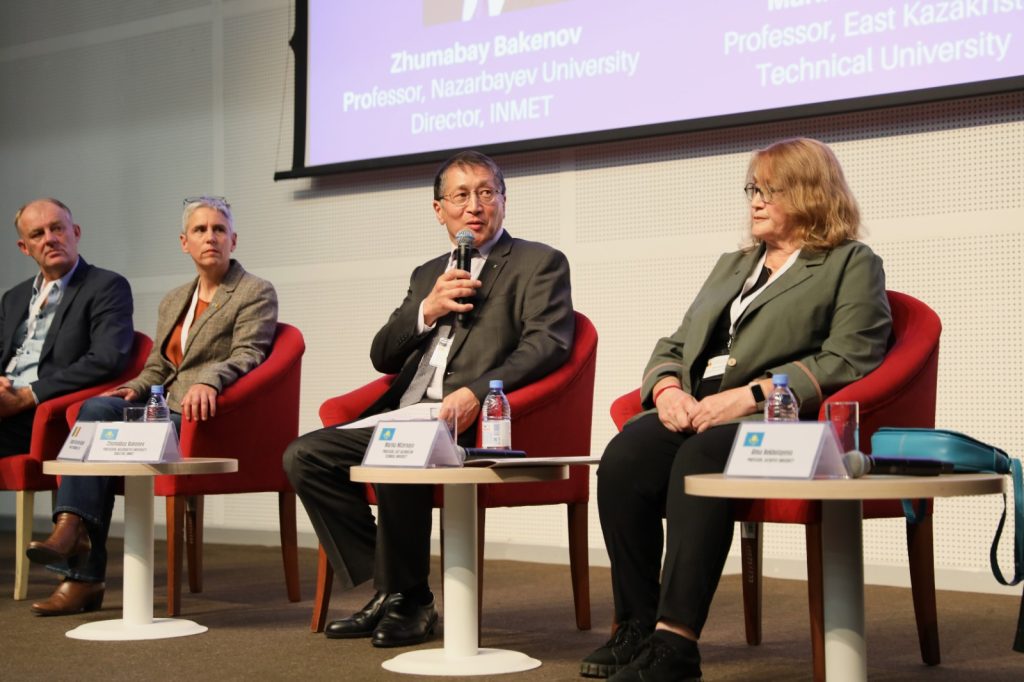
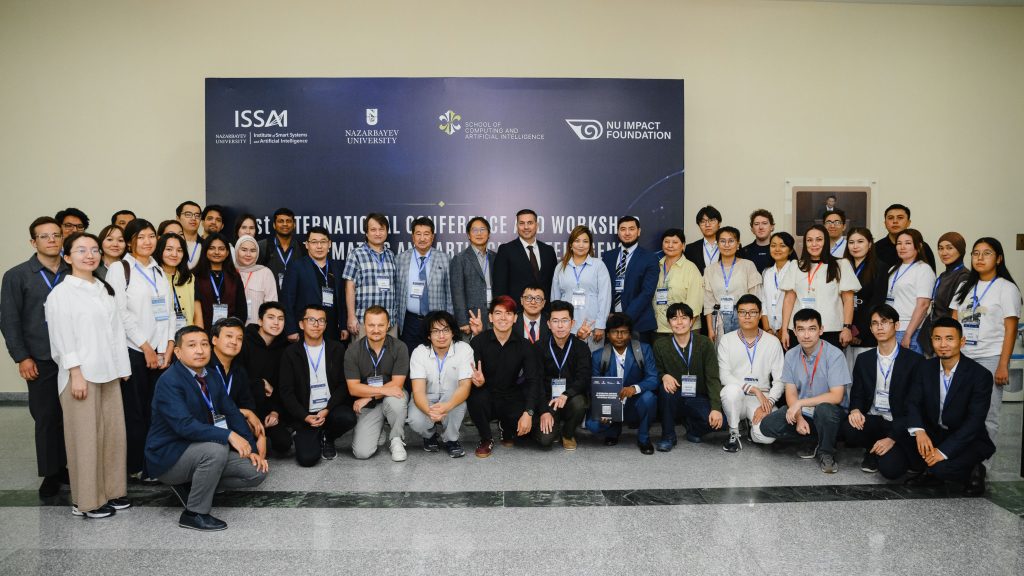
The first International Conference on Mathematics and Artificial Intelligence (ICMAI 2026) brought together 90 participants from Kazakhstan, Russia, Saudi Arabia, the United Arab Emirates, Hungary, Azerbaijan and China to discuss current research at the intersection of mathematics and artificial intelligence.
The conference was organized by the School of Computing Sciences and Artificial Intelligence (SCAI) and the Institute of Smart Systems and Artificial Intelligence (ISSAI). ICMAI 2026 was co-chaired by Professor Huseyin Atakan Varol, Director of ISSAI, and Professor Durvudkhan Suragan of SCAI.
The programme featured seven plenary lectures, 32 sectional talks and four hands-on workshops. Participants explored the mathematical foundations of artificial intelligence, optimization methods, differential equations and mathematical modelling, machine learning, data analysis, trustworthy AI and intelligent systems.
One of the key themes was the role of mathematics in advancing modern artificial intelligence systems. Researchers examined how graph theory, linear algebra, high-dimensional data analysis and other mathematical methods are applied in the development of AI systems. At the same time, artificial intelligence is opening up new possibilities for mathematical research, from identifying patterns and testing hypotheses to tackling complex scientific problems.
The conference programme also included hands-on workshops, giving participants an opportunity to explore modern computational methods and tools for applying AI in research. Undergraduate, master’s and doctoral students from SCAI’s computer science and mathematics programmes also took part in the sessions. For them, the conference provided an opportunity to learn about current research and engage directly with international scholars.
“It was a very exciting and productive three days. With seven plenary lectures, 32 sectional talks and four workshops, ICMAI 2026 brought together researchers and students from different countries and created a valuable space for dialogue between mathematics and artificial intelligence. Our mathematics researchers also actively participated in the workshops, where they explored practical tools and learned how to write and implement code for mathematical and AI-related problems. We are especially pleased that the conference brought these two rapidly developing fields closer together and created new opportunities for international research collaboration. We hope ICMAI will continue to serve as a platform for scientific exchange, practical learning and joint research in Kazakhstan and beyond,” said Professor Suragan.
The conference took place amid growing interest in the use of artificial intelligence in mathematical research. In September, OpenAI reported using AI in work related to the Navier–Stokes equations, including the formalization of mathematical proofs using Lean. Such research highlights the growing potential of AI as a tool for mathematics, while also underscoring the importance of rigorous verification of AI-generated results by the scientific community — one of the issues also discussed at ICMAI 2026.