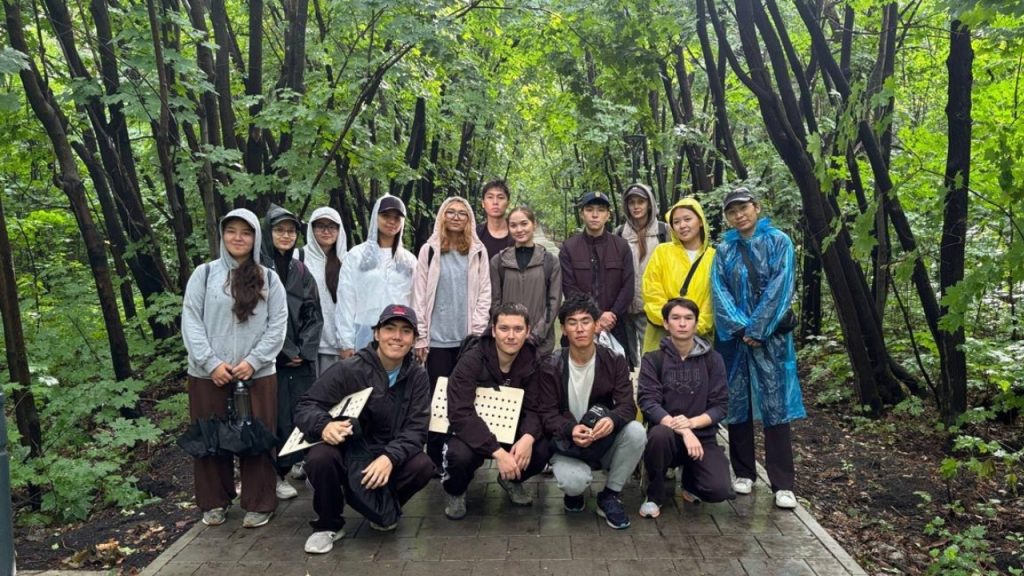
From July 12 to 25, the Burabay National Park became a hotspot for future biologists from Nazarbayev University. The annual summer field program brought together students, leading NU researchers, and faculty from Buketov Karaganda University.
Forests, lakes, and mountains became the classroom for NU students during a two-week field program in Burabay. Instead of learning from textbooks alone, participants immersed themselves in real ecosystems and worked with modern research tools. Organized by the School of Sciences and Humanities (SSH) and the NU Office of Sustainability, this year’s program expanded significantly. A new field laboratory was established at the Burabay research station specifically for the program, enabling students to process and analyze samples directly on site.
From Classroom Knowledge to Field Research
Over the course of two weeks, students gained hands-on experience in every stage of ecological and biological research.
- Field Research and Biodiversity Monitoring: Participants conducted field surveys, installed pitfall traps, collected biological samples, and identified plant and invertebrate species. Their observations were uploaded to the international iNaturalist platform, contributing to global biodiversity monitoring efforts.
- Technology in Environmental Science: The program extended well beyond traditional field biology. Students attended workshops on remote sensing and Geographic Information Systems (GIS), and learned how drones can be used to support ecological research and environmental monitoring.
- Data Analysis and R Programming: Fieldwork was complemented by training in statistical analysis. Participants learned how to organize, visualize, and interpret biological data using the R programming language, one of the most widely used tools in scientific research.
In addition to their field activities, students explored several unique areas of Burabay National Park and visited the biotechnology and forest restoration laboratory of the Kazakh Research Institute of Forestry and Agroforestry, gaining insight into how scientific research supports conservation and ecosystem management across Kazakhstan.
Student Perspectives
For many participants, the experience offered a new perspective on what it means to work in science.
Arina Golovina, third-year Biological Sciences student:
“The field course in Burabay was an incredibly valuable experience because it allowed us to connect theory with practice. It was especially inspiring to learn from professors from different universities who are genuinely passionate about their work. Their enthusiasm made the learning process engaging and motivating.”
Ayazhan Rustemova, fourth-year Biological Sciences student:
“One of the highlights for me was exploring areas of biology that were completely new. Studying zoology and botany in a natural environment and learning from specialists with different backgrounds broadened my understanding of the field.”
Yeldana Zhunuspekova, third-year Biological Sciences student:
“This internship gave us the opportunity to apply the knowledge we gained in class to real-world research. Working in the field, analyzing data, collaborating with other students, and spending two weeks in one of Kazakhstan’s most beautiful natural areas made the experience truly unforgettable.”
Field programs such as this play an important role in science education at Nazarbayev University. Beyond developing technical skills in research, data analysis, and laboratory work, they help students strengthen critical thinking, collaboration, and a deeper appreciation of Kazakhstan’s natural environment and the importance of its conservation.