
A 3D-printed titanium spinal implant developed and manufactured in Kazakhstan has been used in 21 patients undergoing spinal surgery, with researchers following how the implant integrated with bone over the year after surgery. The findings were published in September 2026 in Scientific Reports, a Nature Portfolio journal, demonstrate how research carried out in Kazakhstan can move from laboratory development to clinical application and generate data relevant to the international development of 3D-printed medical implants.
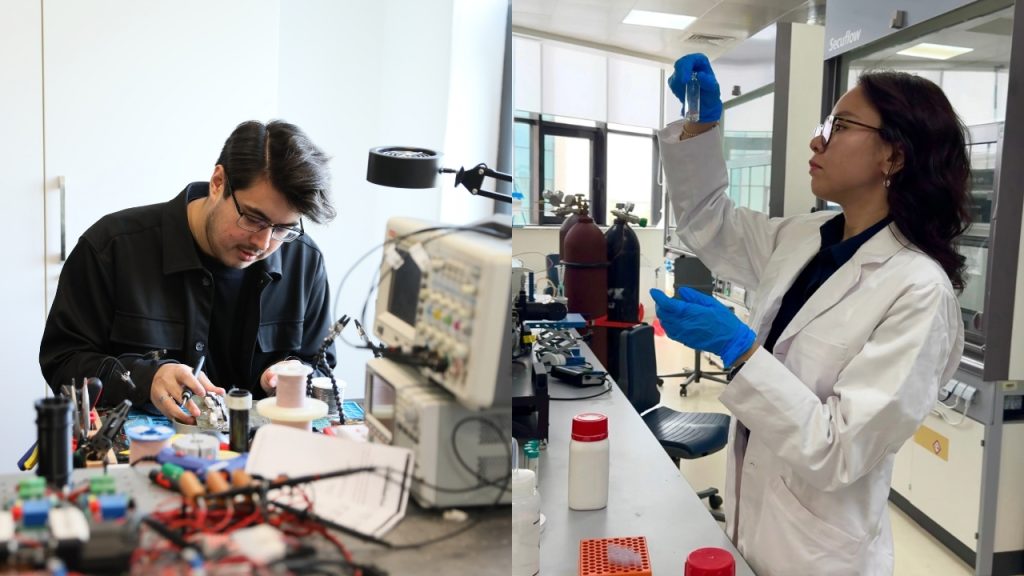
A key role in this study was played by Amanzhol Turlybekuly, researcher at Nazarbayev University’s Institute of New Materials and Energy Technologies (INMET), with Nurmakhan Zholshybek from the NU School of Medicine among the researchers involved. The work also brought together expertise from D. Serikbayev East Kazakhstan Technical University and the National Scientific Center of Traumatology and Orthopedics.
The implant is a 3D-printed titanium device used in spinal surgery. It has tiny spaces that allow bone to grow into it as the patient heals. For the researchers, an important achievement is that the technology moved beyond laboratory development and into real clinical use.
“The important part of this work for us is that a technology developed and manufactured in Kazakhstan has progressed from laboratory research to clinical application. We then had an opportunity to study what happens after implantation and measure how bone grows into the implant over time. This gives us quantitative data that can help us better understand the performance of the implant and guide further development of 3D-printed medical technologies,” says Amanzhol Turlybekuly, lead author of the study and researcher at NU.
The 21 patients were followed for one year, and the researchers tracked how the bone grew into the implants. Patients showed lasting improvements in back and leg pain and their ability to move. 3D printing is being actively studied around the world as a way to produce medical implants with structures designed to support the body’s integration with the implant. Researchers internationally are also working to understand why some implant designs perform better than others.
In this context, the significance of the study is not that 3D-printed titanium implants are new. Rather, it demonstrates that researchers in Kazakhstan can contribute to the full development and testing process: from designing and manufacturing an implant locally, to using it in clinical practice and collecting data on how it performs in patients. For Kazakhstan, this experience could support further work on locally produced medical implants and other technologies that combine advanced manufacturing with medicine. Internationally, the study adds clinical data to research on how 3D-printed implants interact with bone and how this process can be monitored over time.
Scientific Reports is an open-access journal of the Nature publishing group, covering all areas of science and engineering. It is the third most-cited publisher worldwide and attracts attention from both the scientific community and the media. This publication confirms NU’s international recognition and strengthens the university’s status as a center for advanced research.