The findings could help develop more durable electronics for space, nuclear energy and other extreme environments.
Researchers at NU have discovered why a particular structural form of gallium oxide, a semiconductor material, can withstand intense ion radiation without retaining the microscopic damage typically caused by high-energy particles. The study was conducted by Azat Abdullaev, Rustem Tlegenov, Kairolla Sekerbayev and NU Professor of Physics Zhandos Utegulov, in collaboration with international partners from Norway, Finland, South Africa, Hong Kong and the Czech Republic.
The findings have been published in Nature Communications, a journal ranked among the top 2% of physics journals worldwide according to Scopus Sources. The discovery could offer new ways to design more durable electronic materials for applications where exposure to radiation is a major challenge, including satellites and nuclear technologies.
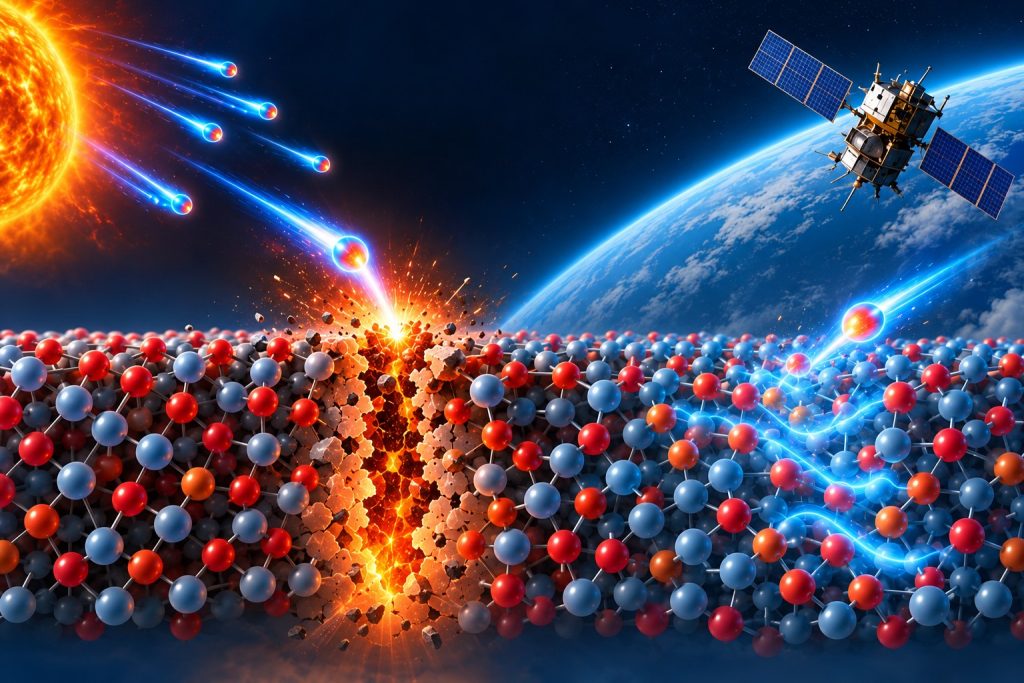
Space is filled with energetic particles that can damage satellite materials and electronic components. Similar challenges arise in nuclear technologies. When a high-energy ion passes through a solid, it deposits energy along its path, potentially disrupting the atomic structure and leaving behind a microscopic trail known as an ion track.
These tracks are invisible to the naked eye but can alter a material’s thermal and structural properties. In effect, they are tiny scars left by radiation exposure. To understand how gallium oxide responds to such impacts, the researchers combined advanced laser-based thermal measurements, electron microscopy and computer simulations.
They found a striking difference between two structural forms of the material. While the structurally rigid form retained microscopic tracks of radiation damage, the more flexible form showed no lasting tracks, even after intense exposure to high-energy ions. Importantly, this does not mean that damage never occurred. Rather, the flexible structure appears capable of recovering after the initial impact, preventing permanent damage from remaining.
The results challenge conventional assumptions about how materials respond to radiation. Materials with low thermal conductivity are generally considered more vulnerable to ion damage because they dissipate heat less effectively. Yet the structurally flexible form of gallium oxide demonstrated remarkable resistance to permanent ion-track formation despite its very low thermal conductivity.
This suggests that a material’s ability to recover from atomic damage may be just as important as its ability to dissipate energy.
The findings could have implications for several technology sectors. In space technology, more radiation-tolerant semiconductors could help satellite electronics operate reliably in the harsh space environment. In nuclear energy, materials better able to withstand radiation-induced changes could contribute to longer-lasting components in nuclear technologies. In advanced electronics, gallium oxide is being explored for high-voltage devices, and understanding how its different structural forms respond to radiation could help researchers improve their performance under demanding conditions.
These applications remain prospective and will require further testing in real devices and different radiation environments. The study points to a potentially new direction in materials science: rather than focusing exclusively on preventing damage, researchers could design materials that are able to recover from it. Understanding how atoms reorganise after extreme events could help develop more reliable materials for environments where conventional semiconductors face significant limitations.