


A few years ago, relatives of Arukhan Kenes encountered a problem familiar to many flower shop owners: sales were growing, but the business itself remained difficult to track. Flowers disappeared through unnoticed write-offs, pre-orders were lost, and inventory was managed across spreadsheets and messaging apps.
Rather than accept the inefficiencies as part of the business, Kenes decided to build a solution. Today, FLORAX.KZ, the digital platform he created, is used by more than 200 flower shops across Kazakhstan and is beginning to expand into international markets.
Kenes, a master’s student in Data Science at Nazarbayev University, has been developing the startup since 2024. Before graduate school, he studied in the NU Foundation program and later abroad, where he actively competed in programming contests and reached the semifinal stage of the 2022 International Collegiate Programming Contest (ICPC) in the Netherlands. According to Kenes, those experiences shaped the way he approaches entrepreneurship.
“For me, technology has never been just a profession — it has been a way to solve real problems,” he said. “I’m interested in building products that help people manage and grow their businesses.”
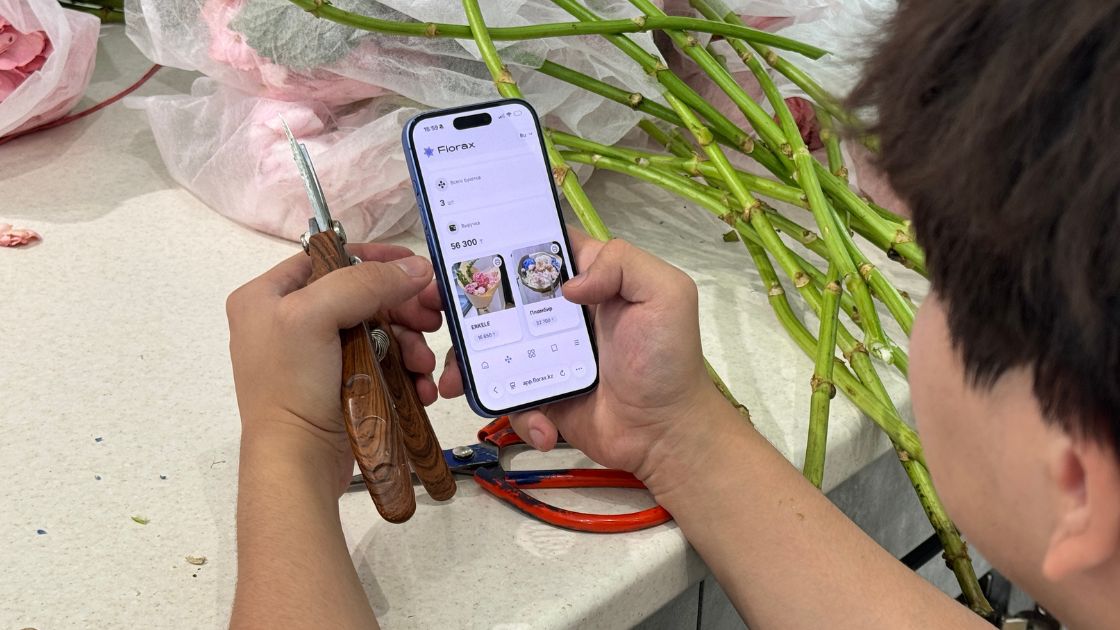
What began as a management tool for a single business has evolved into a broader digital ecosystem for flower shops. The platform now includes an online storefront, pre-order calendar, customer database, loyalty system and analytics tools for monitoring sales, inventory and product losses. One of its most widely used features is mobile access, allowing florists to manage orders and operations directly from their phones.
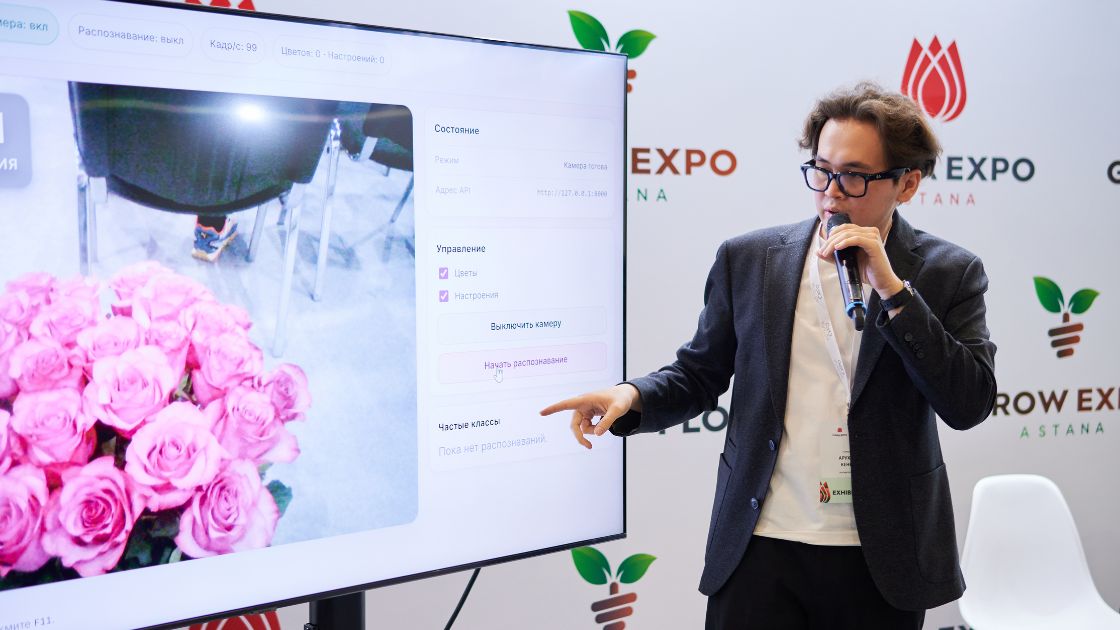
Artificial intelligence has become an increasingly important part of the project. The system analyzes bouquet photographs and gradually learns to identify flowers and their varieties — a task more complex than it might first appear.
“The more a shop works with the system, the more accurate recognition becomes within its inventory,” Kenes explained. “A single rose can have hundreds of varieties and shades. That’s why we are not trying to solve all of botany at once — we focus on the real needs of a specific store.”
Kenes says the project has been shaped not only by entrepreneurial experimentation but also by his academic experience at Nazarbayev University, particularly in artificial intelligence. Faculty mentorship and the university environment have also played an important role in the startup’s development. The project now forms the basis of his graduate thesis, while the flower shop operating on the university campus uses the system free of charge.
Looking ahead, his team plans to continue expanding its AI capabilities. Future tools may support bouquet analysis, pricing recommendations, composition generation, photo enhancement and customer service automation. For Kenes, the startup reflects a broader idea: innovation often begins not in a laboratory, but with an everyday problem waiting to be solved.