

Ensure availability and sustainable management of water and sanitation for all.
How much water is available in Kazakhstan’s rivers, and how does that change from one season to the next? What happens to pollutants when water is treated? At Nazarbayev University (NU), researchers investigate these questions using satellite observations, field measurements, and laboratory experiments. Students study water quality at Lake Shchuchye, learn how Astana treats its wastewater, and develop ways to use water more efficiently on campus.
Water Security in Kazakhstan
Understanding Kazakhstan’s river basins
In a 2025 study, Vadim Yapiyev and colleagues compared Kazakhstan’s major river basins and identified two broad hydrological regions, northern and southern. They distinguished the regions by climate, vegetation zones, and the seasonal behaviour of their rivers. This provides a baseline for comparing water availability across a country where rainfall and river flow vary considerably by location and season. Read the study in Frontiers in Water.
Measuring water from space and on the ground
On 21 October 2026, National Laboratory Astana and NU’s Office of Sustainable Development brought together 60 participants for the final seminar of the Water Budget of Kazakhstan research project, led by Vadim Yapiyev.
The team combined satellite observations with ground measurements to assess precipitation, evaporation, and river flow across five water management basins: Zhaiyk–Caspian, Yesil, Tobol–Torgai, Nura–Sarysu, and Ertis. Researchers and practitioners discussed where the data sources agreed, where estimates needed further checking, and how the WaterBalance Kazakhstan geoportal brings maps and datasets together for this work. Explore the seminar and research project.
Water Quality and Treatment Research
What remains after drinking water is treated? In a 2026 study, researchers examined the sludge collected at a drinking water treatment plant in Astana. They found that lead and arsenic concentrations in the sludge exceeded the benchmarks used to assess its suitability for application to land. The findings show why treatment residues need to be tested before decisions are made about their reuse. Read the study on water treatment sludge.
Can membranes remove metals and dyes? A team involving NU and National Laboratory Astana developed a membrane and tested it against dissolved metals and synthetic dyes. In laboratory tests, the membrane rejected 97.8% of lead ions and 98.4% of methylene blue, one of the dyes tested. The study provides a basis for investigating how the material performs with more complex wastewater mixtures. Explore the membrane study.
Where do trace pollutants go in Astana’s water system? A project led by Woojin Lee at NU’s Laboratory of Environmental Systems examines pollutant concentrations at different stages of the city’s water system. Its aim is to assess how effectively existing treatment and sludge disposal processes manage these substances and where they may pose risks to people or ecosystems. Explore the Astana micropollutant project.
Water Management on Campus
Drinking water and monitoring. Campus drinking fountains give students, staff, and visitors free access to water and a place to refill bottles. NU reports regular drinking water quality checks and meters water consumption in academic buildings, residences, and premises used by tenants.
Landscape irrigation. NU uses automated irrigation for campus green spaces. Non-potable sources include groundwater from boreholes and, during warmer months, water from the Nura–Yesil canal. Flow meters track canal water used for irrigation.
Water treatment and reuse. Campus systems use filtration and disinfection to manage water quality. One example of reuse is the campus car wash, where water is filtered and recirculated for subsequent washes. Explore campus water management practices.
Student Learning and Community Action
Student-designed irrigation
At the May 2025 Sustainability Living Lab conference, an NU student team presented Watermatic, an automated irrigation system designed to conserve water. The project gave students a practical engineering task: build and test a system that controls how water is delivered to planted areas. In 2026, NU’s living lab approach continued through Campus as a Living Lab (CaLLs), which uses university facilities as settings for applied research. Explore the student projects.
Assessing lake water quality in Burabay
From 12 to 25 July 2026, 24 NU biology students took part in a field programme at Lake Shchuchye in Burabay National Park, led by Professors Ivan Vorobyev and Natalie Barteneva. Students collected aquatic invertebrates along the lakeshore and used the organisms they identified to assess water quality. They then compared their assessment with visible signs of human activity at the site. Read about the Burabay field programme.
Learning how Astana treats wastewater
During Sustainability Week 2026, students, staff, and volunteers visited the wastewater treatment facilities of Astana Su Arnasy. Seeing the treatment process on site helped participants connect what goes down a drain with the infrastructure a city needs to manage wastewater. Read about the visit.
Caring for Lake Taldykol
In October 2026, the Office of Sustainable Development and UNICEF jointly organised a clean-up at Lake Taldykol in Astana. Fifteen volunteers removed 250 kg of litter from the area around the lake.
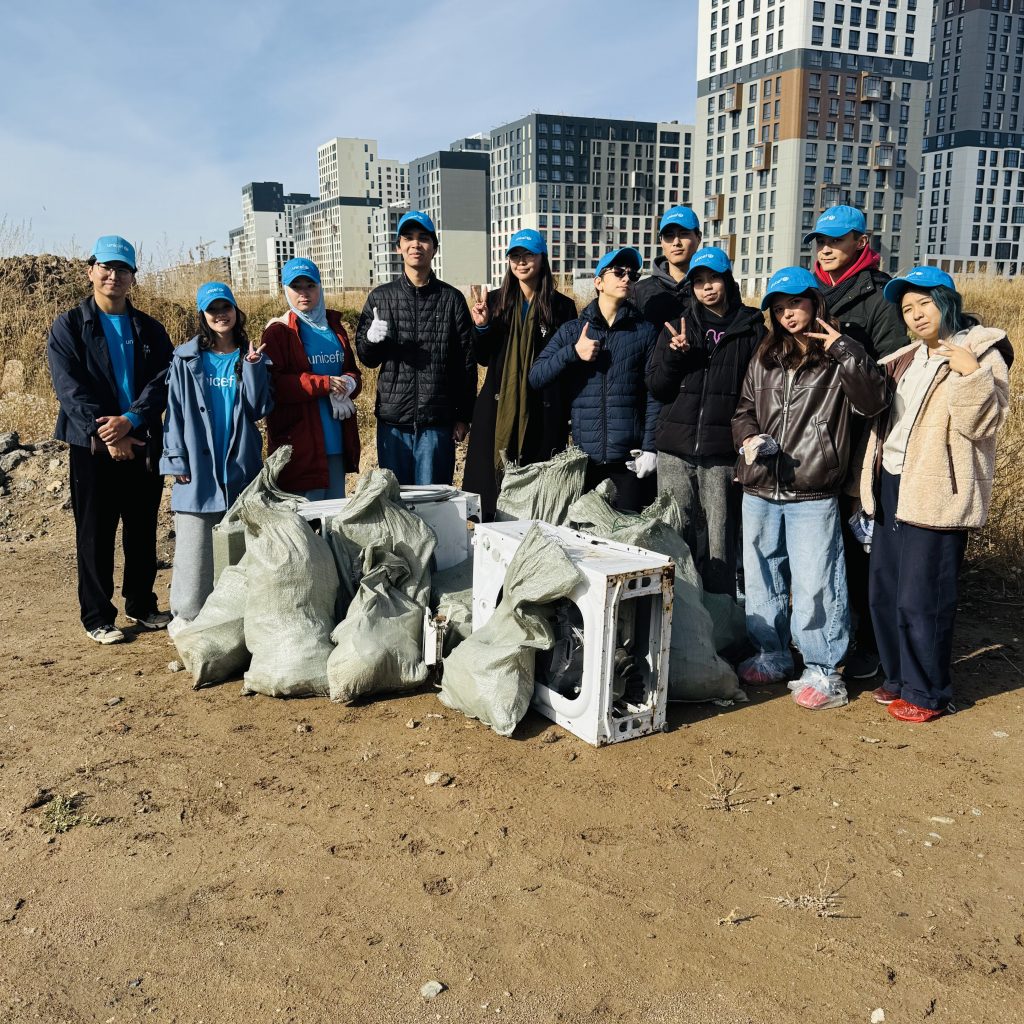
Volunteers at Lake Taldykol during the October 2026 clean-up.