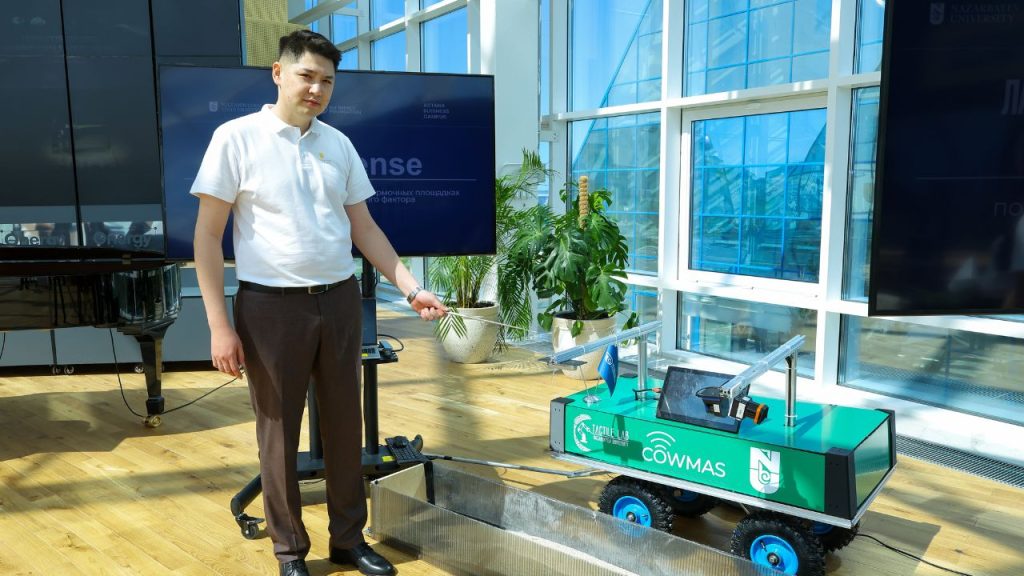
Technology-driven startups aimed at solving practical challenges facing Kazakhstan’s economy are actively emerging at Nazarbayev University. One such project is BunkSense — an intelligent livestock feeding monitoring system that leverages computer vision technologies and automated data analysis.
The project addresses one of the key challenges in modern cattle farming: the inefficient monitoring of feed leftovers at feedlots. A feedlot with a capacity of 10,000 head of cattle consumes approximately 100 tons of feed per day, translating into nearly KZT 15 million in daily feeding costs alone. Despite these figures, feed monitoring processes largely remain manual. During a single shift, a livestock specialist may inspect up to 200 feed bunks, walk nearly 15 kilometers, and visually estimate feed leftovers. Such assessments can have an error margin of up to 10%, while inconsistent feeding regimes may lead to animal stress, disease, and reduced weight gain of up to 7%.
BunkSense offers a digital solution to this problem. The system automatically measures feed leftovers without human intervention, enabling more accurate and consistent feed management.
“Today, there are virtually no automated solutions for measuring feed leftovers across the CIS region. Most existing technologies focus on feed preparation and distribution, whereas BunkSense specifically addresses the objective assessment of what remains in the feed bunk,” says Project Lead Temirlan Galymzhanov.
To date, the team has successfully completed the MVP1 stage. Under laboratory conditions, the system demonstrated measurement accuracy of up to 98%, while controlled semi-field trials showed results ranging from 86% to 97%, confirming the viability of the chosen technological approach.
The project is currently at the MVP2 stage, during which the team is transforming the prototype into a fully operational product ready for deployment in real feedlot conditions. The next phase, MVP3, will focus on developing a fully autonomous system in which a mobile robotic platform will independently navigate the facility and scan feed bunks without staff involvement.
The BunkSense team was formed within the academic ecosystem of Nazarbayev University. Project Lead Temirlan Galymzhanov is a PhD student specializing in robotics. Airis Kairolla, a university student, is responsible for computer vision, 3D reconstruction, and software architecture, while Master’s student Miras Muratkanov oversees the robotics component of the project, including the mobile platform and drive systems. University professors and advisors are also actively involved in the startup’s development.
According to the team’s estimates, implementing the system at a 10,000-head feedlot could generate economic benefits of up to KZT 100 million annually through reduced feed losses and improved feed efficiency. In addition, the technology has the potential to increase livestock productivity by up to 7%.
The project’s scaling potential extends beyond Kazakhstan to the broader CIS market, where direct competitors in this niche are currently almost nonexistent.
“We envision BunkSense as a fully autonomous feeding monitoring system: a robot independently scans feed bunks, real-time data is transmitted to a digital twin of the feedlot, and livestock specialists make decisions based on objective data rather than visual estimates,” Temirlan Galymzhanov explains.
According to the developers, Kazakhstan’s agricultural sector is currently undergoing rapid consolidation, with feedlots housing tens of thousands of cattle becoming increasingly common. Under these conditions, manual process management is becoming less effective, prompting the industry’s gradual transition toward precision livestock farming driven by data and automation.
The project’s strong potential has already received recognition at the governmental level. Following the project presentation, the Prime Minister of the Republic of Kazakhstan instructed relevant government agencies to explore the possibility of including BunkSense in state support and funding programs for innovative projects. At the same time, the team remains open to cooperation with industrial partners, investors, and representatives of the agricultural sector.