
About us

SDG 2: Zero Hunger

sdg osd 4 Food security depends on access to nutritious food and on agricultural systems that can respond to environmental, economic, and social pressures.

End hunger, achieve food security and improved nutrition, and promote sustainable agriculture

Food security depends on access to nutritious food and on agricultural systems that can respond to environmental, economic, and social pressures.

Nazarbayev University contributes through research in nutrition and agriculture, support for food-related innovation, targeted student assistance, and engagement with sustainable farming practices.

Research and Innovation

diet atlas Food security depends on access to nutritious food and on agricultural systems that can respond to environmental, economic, and social pressures.Central Asia’s Digital Food Atlas

NU’s Central Asia Food Innovation Lab has developed a digital food atlas to support more accurate dietary assessment in the region.

Presented in 2026, the atlas includes 115 foods and dishes, documented with measured portions under laboratory conditions. It provides a regional reference for studying dietary patterns and developing digital nutrition tools.

The atlas supports portion-size assessment; it does not independently calculate calorie or nutrient intake.

Learn more about the food atlas

Improving Wheat Production Efficiency

A 2025 study by Alisher Tleubayev and Yerzhan Syzdykov examines the technical efficiency of wheat-producing farms in Kazakhstan and its relevance to regional food security.

The research considers how farm size, subsidies, access to finance, agricultural insurance, and farmers’ education relate to production efficiency. Its findings contribute evidence for discussions on agricultural support and farm management.

Explore the publication

Plant-Based Foods and 3D Food Printing

Research involving NU scientists explores how 3D food printing could support the development of meat alternatives using plant proteins available in Central Asia.

A review examines lentils, soybeans, peas, and buckwheat, identifying buckwheat as a promising ingredient for products suited to regional dietary preferences.

Explore the publication

Artificial Intelligence for Crop Protection

The Y-Net study presents an automated approach to identifying and counting agricultural pests using images and deep learning.

Designed for devices with limited computing capacity, the approach could help growers monitor pest populations and make informed crop-protection decisions.

Explore the publication

Detecting Food Spoilage During Storage

An active NU research project for 2025–2027 is developing gas-sensing technologies combined with artificial intelligence to detect early signs of agricultural product spoilage.

The project aims to improve storage monitoring and help reduce post-harvest losses. Its planned outputs include a sensor device with machine-learning capabilities for real-time monitoring.

Explore the research project

Climate, Water, and Rural Livelihoods

Research involving NU examines the connections between climate change, water scarcity, and population mobility in rural Central Asia.

The publication identifies priorities for studying smallholder adaptation and the effects of water pressures on rural livelihoods, calling for stronger collaboration and better evidence to inform policy.

Explore the publication

Innovation for Sustainable Food Systems

69311a31ef1fa Food security depends on access to nutritious food and on agricultural systems that can respond to environmental, economic, and social pressures.FoodSave: Reducing Food Waste

FoodSave was selected for support through Social Startup 2025, a national programme implemented by NU Impact Foundation.

The platform helps businesses offer unsold food products at reduced prices, connecting food-waste prevention with more affordable purchasing opportunities.

Read about Social Startup 2025

EGIStic: Digital Tools for Farmers

EGIStic, featured in the NURIS startup portfolio, provides tools for farm management and precision agriculture.

The platform uses satellite imagery to assess field conditions and identify areas requiring attention. It also supports planning, crop-rotation records, inventory management, and machinery monitoring, helping farmers make informed operational decisions.
Explore EGIStic

Access to Food and Student Support

Targeted Meal Support

NU provides meal support for eligible Foundation Programme students who have lost both parents, as part of its assistance for socially vulnerable student categories.

Students can contact the Department of Student Services for information on eligibility and supporting documentation.

Learn more about student support

NU Impact Foundation Support Programme

NU Impact Foundation’s Support Programme assists applicants and students facing difficult circumstances. Its documented activities include providing meals to Foundation Programme students.

The Foundation reports that more than 700 Foundation students received free meals during 2018–2020, demonstrating a practical contribution to meeting students’ essential needs.

Learn more about the Support Programme

Learning and Partnerships

5 5 Food security depends on access to nutritious food and on agricultural systems that can respond to environmental, economic, and social pressures.NutrIX 2026: Nutrition and Food Systems

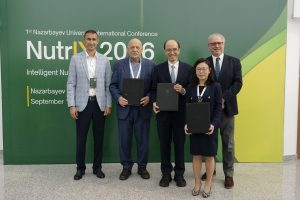
In September 2026, NU hosted the first International Conference on Intelligent Nutrition and Food Systems for Precision Health, NutrIX 2026.

The conference brought together more than 20 international speakers, alongside representatives of WHO and FAO. Discussions connected nutrition, public health, data science, and food systems, with attention to regional dietary needs and the accessibility of healthy nutrition.

Read about NutrIX 2026

Up

 © Nazarbayev University

Republic of Kazakhstan, Astana city, 53 Kabanbay Batyr Ave.