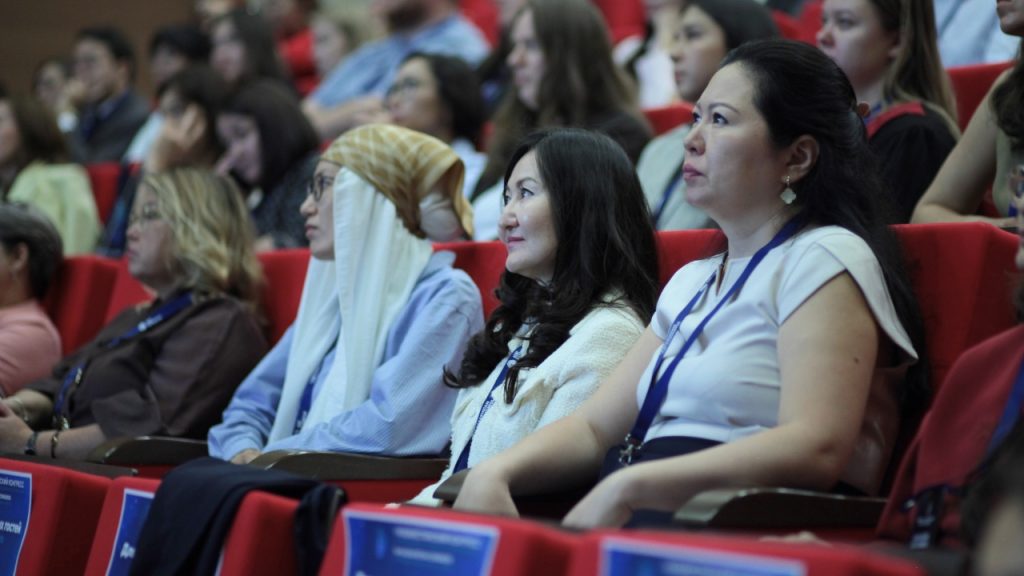
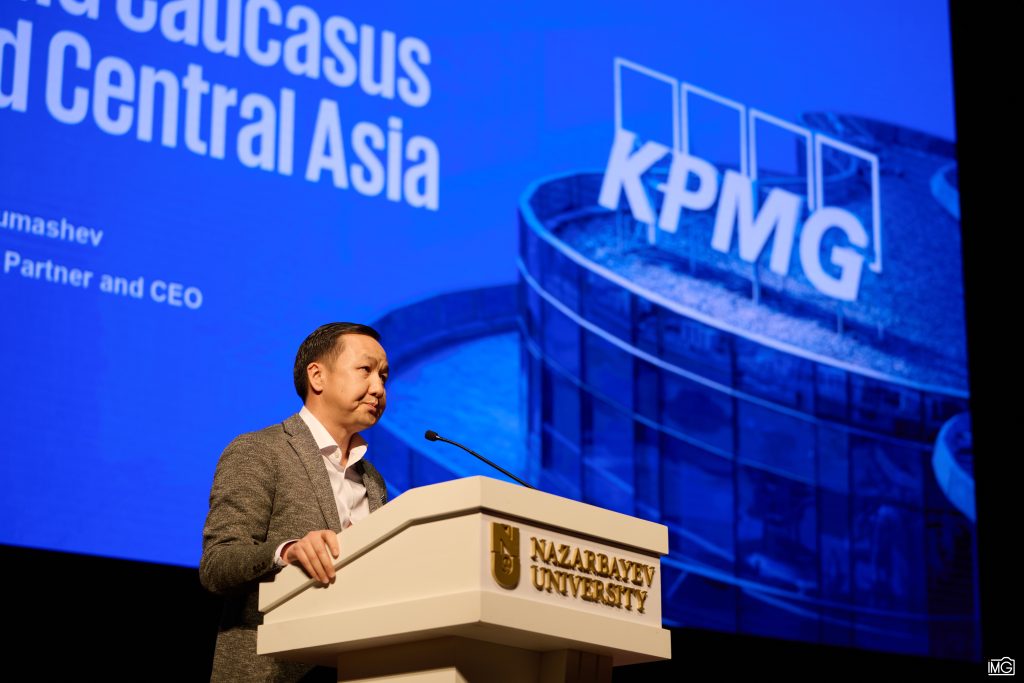
Saken Zhumashev, Managing Partner & CEO of KPMG Caucasus and Central Asia, met with an audience at Nazarbayev University (NU) — an institution actively shaping Kazakhstan’s intellectual and professional agenda. The purpose of the meeting was to share practical insights on the transformation of financial markets, the impact of global turbulence on the tenge, and the competencies that will be in demand in the near future.
The event was organized by the NU student community Economic Leadership Society. Thanks to their initiative, around 500 participants — professionals and enthusiasts in finance, economics, analytics, and consulting — gathered on the NU platform.
“We met with students to have an open and honest conversation about the future — about the tenge, trends, and, of course, talent. Looking at a full hall of young people with genuinely inspired eyes, you realize: our future is already here, in these very rows.
The world is changing faster than textbooks can be written, and we reflected on how not to get lost in it. We also discussed the economy, trends, and AI agents that will soon take over routine tasks. In this reality, what remains for humans are the most important things: strategy, empathy, and the ability to connect meaning. The leaders will not be those who have accumulated the most knowledge, but those who adapt the fastest and are not afraid to try new things,” Zhumashev noted in his post-event reflection.
According to his observations, NU supplies the largest number of specialists to Big4 firms in Kazakhstan, many of whom demonstrate knowledge at or above the level of graduates from Western universities. We have compiled 7 key insights from this meeting with a global consulting leader.
From London to the Russian hinterland — consulting as a school of adaptability
Starting his career in the Big4 in 2005, Zhumashev’s first projects took him abroad: London, then an island in the English Channel — international platforms. His next assignment, however, sent him deep into Russia, to an aluminum plant in a town of 30,000 people.
The contrast between the global business environment and local industrial reality became a true school of adaptability. Consulting here is not just about numbers — it is an opportunity to immerse oneself in real business processes across industries, from oil and gas to agriculture, and to understand how the economy works from within.
Oil, rare earths, and construction — sectors shaping the future
There is a perception that oil is “dying,” but in reality it remains a strategic resource: its price is rising, and oil is needed not only as fuel, but also for clothing, pharmaceuticals, and organic materials.
Rare earth metals are critical for future technologies, including space projects. Elon Musk, for instance, requires these resources for spacecraft and Mars missions, highlighting their global importance. These sectors of Kazakhstan’s economy will continue to develop.
Construction demonstrates a strong multiplier effect: metal, concrete, labor — all are involved. Companies are also successfully exporting their expertise abroad — to Vietnam, Toronto, and Miami. In numbers: the sector grew from 5 trillion tenge in 2020 to nearly 11 trillion in 2025.
Transport and logistics are also transforming: Kazakhstan is gradually becoming a “land-linked country,” connecting regional economies and strengthening transit flows. This requires the construction of terminals, warehouses, and railway infrastructure.
Together, these sectors form the foundation for future economic growth and attract foreign investment, reinforcing the country’s strategic position globally.
Big4 as economic infrastructure and a growth indicator
The Big4 are not just about auditing — they represent a comprehensive institution that accumulates and applies various forms of knowledge: from implementing IT systems to developing tariff methodologies and tax regulation frameworks. In this sense, they act as active participants supporting the entire financial and economic “circulatory system.”
This scale is reflected in KPMG itself: 300,000 employees worldwide, presence in 140 countries, and increasing regional integration. The Caucasus and Central Asia region is becoming more interconnected, with Kazakhstan remaining the largest practice. An important indicator is the scale of the local team: around 950 employees in Kazakhstan, approaching the milestone of 1,000 — a level not yet reached by any Big4 firm in the country.
At the same time, Big4 dynamics directly reflect the state of the economy: more projects mean more business activity, investment, and deals. Consulting thus becomes not only a market participant but also its indicator.
What distinguishes an expert from a passive consumer of information?
One recommended read is Made to Stick: Why Some Ideas Survive and Others Die. One of its key lessons: ideas gain power when grounded in facts.
In today’s world, critical thinking is essential. Take GPT: it provides confident answers but can sometimes be wrong. Verification, cross-checking, and the ability to ask the right questions distinguish an expert from a passive consumer.
Content is now produced at massive scale, often with AI. Even books can be generated in bulk — to the point that platforms like Amazon impose limits. The same applies to education and financial services: old models are becoming obsolete.
In our company, we already use tools for deep-dive data and research analysis. This is no longer a luxury but a necessity: in the era of big data and AI, critical thinking is what keeps you from drowning in information.
Finance is a circulation system, not just an exchange rate
When discussing finance, it is important not to reduce it to exchange rates — such a view misses the essence. The key question is how money circulates within the economy.
Money can be seen as value, as a resource, or even overvalued — but fundamentally, it is a tool, a commodity that enables the exchange of goods and services. When approached correctly, money begins to create value and movement.
In this system, trust-building institutions play a crucial role. Big4 firms act as such institutions by verifying financial reporting.
In fact, they audit approximately 60–70% of the market. This means that verified reporting shapes understanding of company performance and informs investor decisions.
Banks evolve into ecosystems, digital assets reshape the rules
By 2030, Kazakhstan’s financial system will become more diversified and technology-driven. Today, it remains bank-centric: around 90% of assets are concentrated in banks.
Banks are transforming into ecosystems where digital financial assets play a key role. Startups in payments, DeFi, and tokenization may disrupt traditional banking if major players fail to adapt.
New categories will emerge — such as payment banks that do not take deposits or issue loans but handle transactions. This is crucial for export development and global integration.
Special attention will be given to capital markets: synergy between the Kazakhstan Stock Exchange and the Astana International Financial Centre will expand opportunities and introduce more flexible instruments.
Financial sector: from products to ecosystems
Kazakhstan’s financial sector is evolving from traditional products — deposits, loans, and cards — into full-scale digital ecosystems. Banks are no longer just service providers; they are becoming platforms where users can shop, sell assets, or even complete legal transactions — similar to an online marketplace.
Digitalization has already delivered results: around 90% of payments are cashless, and 70% of transactions occur within bank ecosystems. This enhances market efficiency and expands opportunities for both businesses and customers.
Photo: NU Image