Groundbreaking research from Kazakhstan is spotlighted in a special issue of RSC Advances, a leading publication by the Royal Society of Chemistry.
Electric vehicles, smartphones, microchips—modern life runs on compact, reliable, and increasingly sustainable energy storage. Kazakhstan’s research community is stepping confidently into this global race, with researchers from NU, National Laboratory Astana (NLA), and the Battery Institute earning recognition from one of the world’s most respected scientific publishers. A selection of their recent innovations has been published in a special RSC Advances (Q1 in Scopus) issued by the UK’s Royal Society of Chemistry. The edition is dedicated to the findings presented at the 2024 International Conference on Nanomaterials and Advanced Energy Storage Systems (INESS).
Turning coffee waste into power
What if your morning coffee grounds didn’t go in the trash—but into a battery? A team led by Assistant-professor Aishuak Konarov at NU, in collaboration with Sejong University (South Korea), has developed a method to thermally process spent coffee grounds into a energy-storing material. The result is a phosphorus-doped hard carbon that shows significant promise as a component in sodium-ion batteries—an affordable and eco-friendly alternative to lithium-ion systems. The researchers optimized conditions to enhance the material’s porosity, significantly improving its energy storage performance.
Chemical “nanoreactor”
Miniaturization meets chemistry in a new micro-reactor system developed by the research teams led by Asistant-professor Salimgerey Adilov and Professor Nurxat Nuraje. Their innovation grows specialized polyaniline nanofibers that form a robust 3D structure capable of storing and delivering energy more efficiently. The potential applications? Next-generation supercapacitors for electric vehicles and portable electronics.
Compact lithium-sulfur batteries
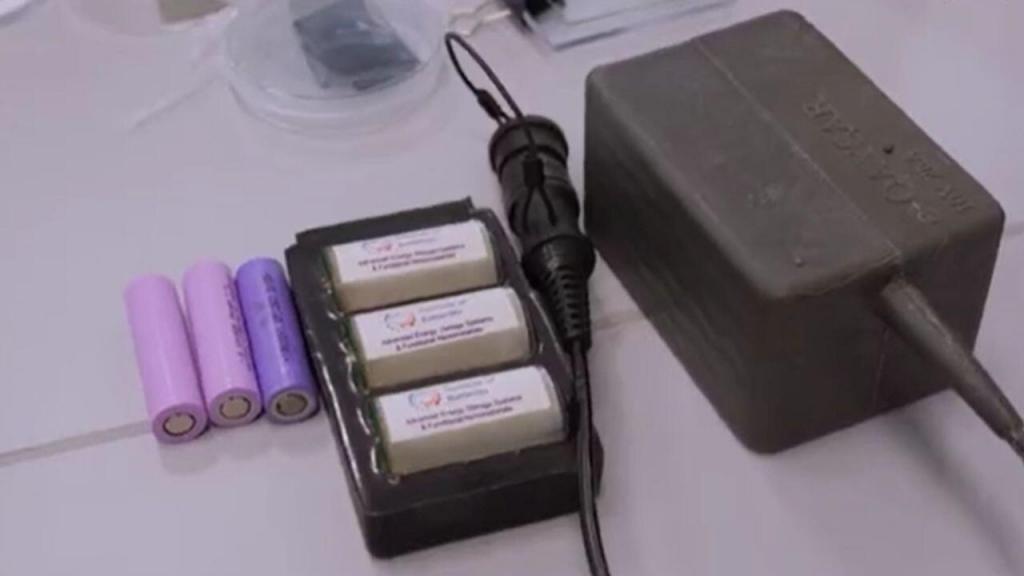
Under the leadership of Dr. Aliya Mukanova, NLA researchers have advanced Li-S (lithium-sulfur) micro-batteries, which are compact, stable, and capable of high energy density. The team simplified the battery’s internal architecture by removing the traditional separator—the thin membrane that prevents short circuits but allows ion flow. The result is batteries with improved theoretical capacity and longer life cycles, retaining up to 60% of capacity after extended use. These compact power sources are ideal for wearable tech and micro-devices such as medical sensors and microrobots.
Can magnets improve batteries? Yes, actually
In a clever twist, a group led by Professor Zhumabay Bakenov enhanced the performance of lithium-iron-phosphate (LFP), a popular and affordable cathode material known for its environmental safety. The problem: capacity loss under high-current or long-term use. Their solution involved adding magnetic nanoparticles to the cathode material and using a magnet during drying. This novel step helped reconfigure the internal structure, boosting lithium-ion mobility and overall performance. The method is simple, scalable, and could readily integrate into commercial battery production.
Supermaterials and metallic foam
Under Dr. Arailym Nurpeissova’s guidance, researchers have engineered a novel battery material by layering nickel oxide onto a porous metallic foam and adding a carbon coating. This architecture increases lithium-ion batteries’ durability and efficiency—making them well-suited for emerging technologies, from EVs to microelectronics.
Kazakhstani researchers are not just improving energy storage—they’re reducing dependence on rare and expensive metals, moving the world closer to accessible, sustainable technology. These innovations will retake center stage at the upcoming 13th INESS, held August 6–8, 2025, in Astana. The event will honor the centenary of Yevney Buketov, a pioneering Kazakhstani chemist who made lasting contributions to metallurgy and scientific development in Central Asia.