Young Researchers Discover the World of Archaeology at the NU Camp
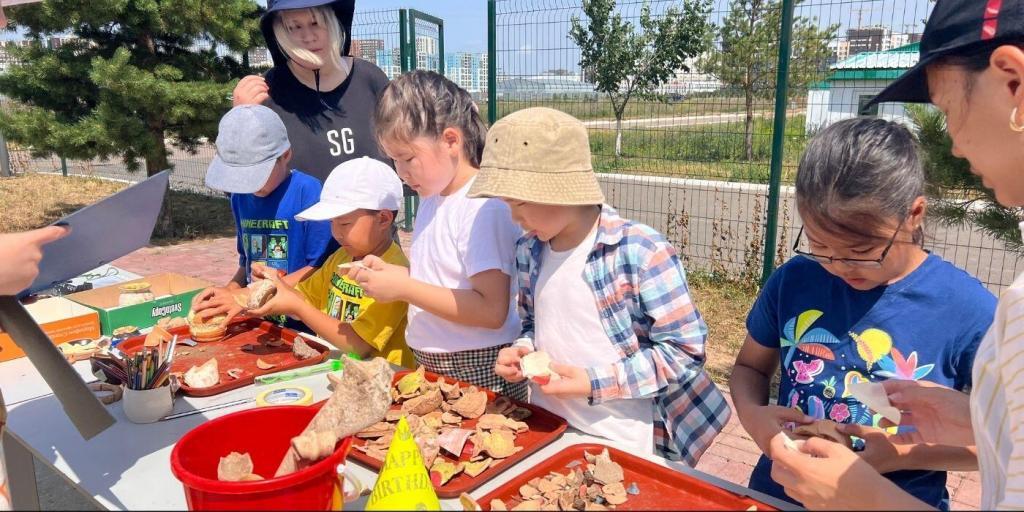
NU held its third annual English-language archaeology camp for children at the university’s Anthropology Laboratory. For a week, children aged 8 to 11 engaged in hands-on learning designed to spark interest in archaeology and strengthen the connection between the university community and the wider public. The children became fascinated with archaeology through a lively and practice-oriented format.
The participants worked closely with professional archaeologists and NU students, learning how scientists study the past. Each day began with an introductory lesson covering a new topic and vocabulary, followed by practical work at the Outdoor Archaeology Lab. Under the guidance of instructors, student mentors, and volunteers from NIS with basic anthropology knowledge, the children learned to use tools, analyze finds, and developed archaeological thinking.
Additional sessions at the end of each day helped reinforce the acquired knowledge and reflect on the day’s topics. Upon completion, the children gained a basic understanding of archaeology, improved their observation skills, critical thinking, and appreciation of how archaeology helps study human history.
Each participant received a certificate of completion, a homework kit, and themed worksheets to continue exploring archaeology independently.
The NU Archaeology Camp demonstrates the university’s commitment to educational outreach and community engagement, offering children a meaningful and engaging introduction to the world of science, discovery, and history.
The NU Anthropology Laboratory was opened on December 2, 2016. It is used both for teaching— in courses such as “Human Evolution” and “Laboratory Methods in Archaeology”—and for research, including analysis of ceramics, bones, and stone tools. The laboratory is also equipped with digital archaeology technologies: it carries out 3D reconstruction of archaeological objects and spatial analysis of artifacts using Geographic Information Systems (GIS).
We invite you to learn more about the laboratory’s work on Instagram: @anthrolab_nu