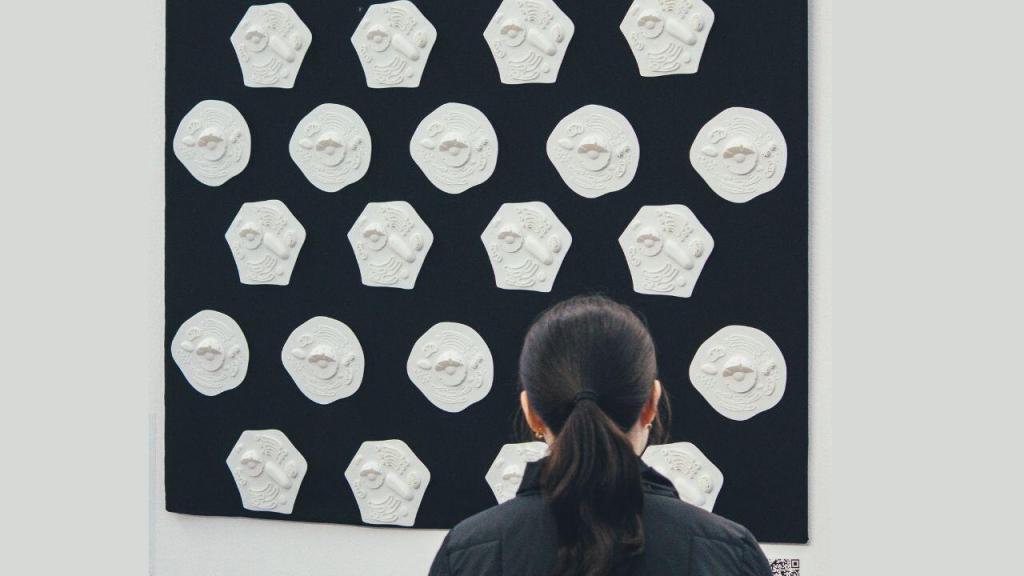
BioArt is an emerging trend in art that is an unusual combination of scientific and creative fields. As the name suggests, BioArt focuses specifically on biology, allowing for reflection on its accelerated development and the consequences of its progress within the framework of social dilemmas and debates.
“In Vivo: Human Diversity” bio art exhibition is part of the students” outreach efforts to promote science in Kazakhstan. Inclusiveness is an essential aspect of the event, so the exhibition is adapted for the visually impaired with accompanying audio descriptions and descriptions of the works in Braille. Adaptation of the artworks for visually impaired people is supported by the “Dara” charity fund and Social Development Fund.
Malika Vasilovai, iGEM team leader: “Last year, we won a grant from the NU Social Development Fund, and now we have an opportunity to tell stories about science in unusual and interesting ways. In Vivo: Human Diversity from the point of view of biology means “delving into the living diversity of man”. Diversity is impossible without inclusivity. We want to expand the understanding of the role of humans in the ecosystem, ideas and values. We ask the eternal question again, “Who are we?” using the synergy of the height of scientific thinking and the depth of fine art.”
By creating a dialogue between science and art, the organizers chose several platforms for self-expression and reflection. Species & Ecosystem abuse is an attempt to look at ourselves from different angles, as if from the outside view. Decolonial biology, or optics, allows you to look at the world outside the palette of oppression and anthropocentrism. The desire to reveal human diversity is achieved through the microscopic and macroscopic gaze. The exhibition audience was particularly interested in experiments with biofantastics. The exhibition also features the works of visually impaired children from school No. 10 in Astana.
The idea for the exhibition came from curators Sultan Musakhan and Aigerim Mazhitkhan, who presented their joint installation “Egoistic Gene” for the first time at the show “Kaita zhukteu. Reboot” in 2018. “Egoistic Gene” is about the trace each person leaves behind, whether it’s an offspring, a project, or a scientific work – the viewer is free to decide that for himself.
Gulmira Zholayeva, in her series called “Breath of the depth”, showed images caused by her imagination in search of an answer to the question of how fish and human body parts can change in the future.
Artist Laura Eskozhina in her ceramic work “Andromeda Flower”, implements the idea of what flowers can be on another planet. The artist tried to create a unique series about how she and scientists would change the Earth’s flowers after seeing a plant on another planet.
Amateur artist Bibarys Gilazh presented a combination of a robot and an animal using graphic tools. Biohacking is a program for the future. It allows you to understand the works from different angles. The main ideas are the limits of evolutionary development, recreating red-listed animals with robots, and creating technical means of protection for animals whose population is declining.
It is known that science and art have been closely intertwined for centuries. Discoveries in science influenced art and vice versa. Saule Malieva, in her work “The Birth of a New World”, emphasized the connection between science and art through the image of the baby Leonardo da Vinci, who thoroughly studied anatomy.
Sculptor Zhanna Nugerbek, in the project “Third Eye”, considers the issue of preserving saigas listed in the “Red Book”. According to the author’s idea, the “third eye” will help the animal to know when poachers are approaching or where arable land is to avoid them.
Another installation called “Friday”, created by Mansur Smagambetov draws attention to the importance of caring for the Earth.
The NU Student organization iGEM intends to raise funds and support the Remisee project, which aims to improve the quality of education among students with total blindness and residual vision.
The exhibition at NU will be open until October 2nd. It will be held then at the exhibition centre Kulanshi from October 27th to November 10th.
On behalf of the NU iGEM student organization, exhibition director Anel Umirbaeva and inclusive environment organizer Zere Mamadil expresses their endless gratitude to NU faculty and administration, curators Sultan Musakhan and Aigerim Mazhitkhan, artists, students of the Gymnasium No. 10 named after Z. Tashenov, sponsors – Hope Foundation, DARA Foundation, NU SDF and the Budget Committee of the Student Government for their support in organizing this event.
About iGEM
The International Genetic Engineering Machine (iGEM) is an annual space-scale competition in synthetic biology and related disciplines among the best universities in the world. The purpose of the competition is to create a working strain, apparatus or computer algorithm for human needs. NU Student organization iGEM was established in 2014. In its history, students were awarded the gold medal twice and the best environmental project in the world, overtaking Harvard, Stanford and the Massachusetts Institute of Technology.