
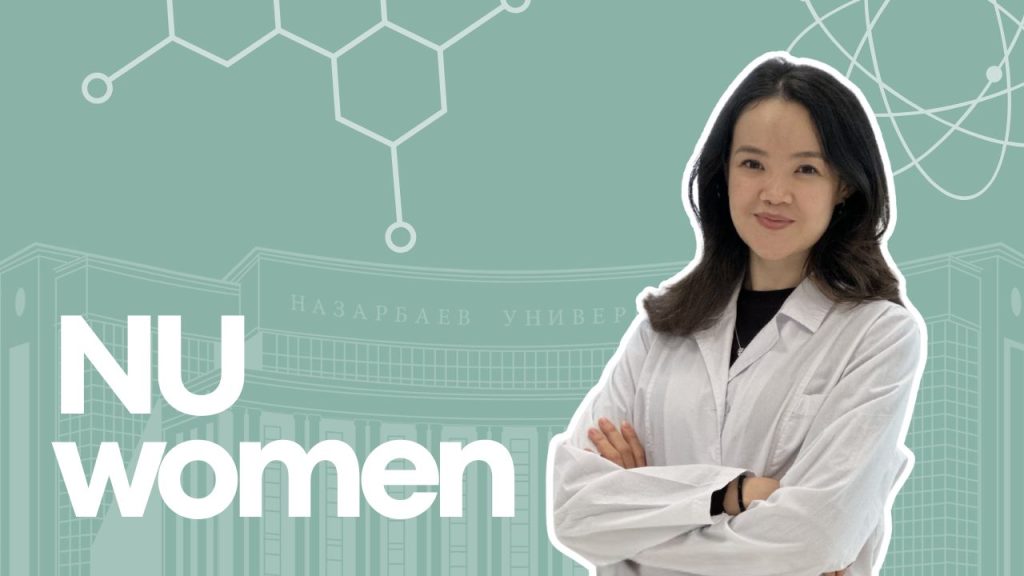
The white lab coat is most often associated with doctors. But behind the doors of research laboratories, other specialists wear it as well—scientists who work not with scalpels, but with formulas, microstructures and molecules. One of them is Guldana Zhigerbayeva, a researcher at the Institute of New Materials and Energy Technologies (INMET) at Nazarbayev University. Her work focuses on conductive polymers, materials that combine the flexibility of plastic with the electrical properties of metals—an emerging technology that is reshaping electronics and medical devices.
“When I put on a lab coat, I feel a sense of focus and inner discipline,” she says. “It’s not just clothing. It’s the uniform of an expert.”
Last year, in the laboratory where Zhigerbayeva is working an accelerated method for synthesizing a two-dimensional polymer with high electrical conductivity was developed. Scientists sometimes describe conductive polymers as “plastics with the character of metal.” They retain the lightweight and flexible properties of plastic while conducting electricity, making them ideal for next-generation technologies.
As the global electronics industry moves beyond rigid silicon components, demand for such materials is growing rapidly. Conductive polymers are increasingly used in flexible displays, wearable devices, medical sensors and neural interfaces.
“Our research makes it possible to create foldable smartphones and rollable screens that can withstand hundreds of thousands of bending cycles,” researcher explains. “In medicine, we are addressing the problem of ‘hard within soft.’ Metallic chips implanted in the body can cause inflammation, while conductive polymers are biocompatible and much closer to the mechanical properties of living tissue.”
Another promising direction is smart textiles. Conductive polymers can be integrated into fabric fibers, turning an ordinary T-shirt into a health-monitoring device capable of recording electrocardiograms or analyzing the chemical composition of sweat.
Despite the promise of the technology, challenges remain. Conductive polymers gradually degrade when exposed to oxygen and moisture, limiting their long-term stability.
“We are developing new chemical compositions that increase the durability of these materials and testing them under conditions close to real life,” she says. “For example, we examine how the material behaves after 10,000 bending cycles or prolonged exposure to sweat. For me, success means creating a prototype sensor or chip that performs better and costs less than existing alternatives.”
Science has also shaped Guldana’s personal life. She met her future husband while studying for her master’s degree at Nazarbayev University. Yerbolat Magazov, who holds a doctorate in chemical engineering, conducts research in green energy technologies. Their relationship, she says, is built in part on shared intellectual curiosity.
“We understand each other’s professional world. It’s rare when your partner can be both your strongest critic and your greatest supporter. That kind of synergy strengthens not only a relationship but also professional growth.”
For her, the long-standing notion that science is “not for women” is rapidly becoming outdated. In her undergraduate chemistry program, women made up about 70–75% of the class—a trend that continued through graduate studies.
“Materials science is not about gender,” she says. “It’s about analytical thinking and engineering intuition.”
Yet structural challenges persist. Women in science often feel they must work harder to prove their professional credibility, she says. Academic careers also come with heavy demands: teaching, publishing research papers, securing grants, supervising students and fulfilling administrative responsibilities—all while balancing personal life.
“Many women in science experience chronic fatigue,” Guldana says. “Loss of motivation often happens not because of a lack of talent, but because of overload.”
She believes stronger institutional support could make a difference, including access to childcare, housing programs and clearer social guarantees for researchers.
“History offers an instructive example. During the formative years of Kazakhstan’s Academy of Sciences, its founding president, Kanysh Satpayev, arranged housing construction for scientists funded by the academy and opened specialized stores for researchers. Scientists were treated as part of the intellectual elite,” researcher says. “The state deliberately freed them from everyday concerns so they could focus on creating knowledge. Strong science is impossible without a secure and stable researcher.”
Guldana grew up in a family of academics: her father is a professor of agricultural sciences and her mother holds a doctorate in education. Outside the laboratory, she describes herself as a creative person interested in dance, music, painting and photography—interests she sees as closely connected to scientific work.
Asked what defines the strength of the modern woman scientist, she answers without hesitation. “It is resilience, discipline and the ability to work effectively under pressure,” she says. “Her strength lies not only in adapting to a complex system, but in continuing to create new knowledge and move science forward—even when resources are limited.”