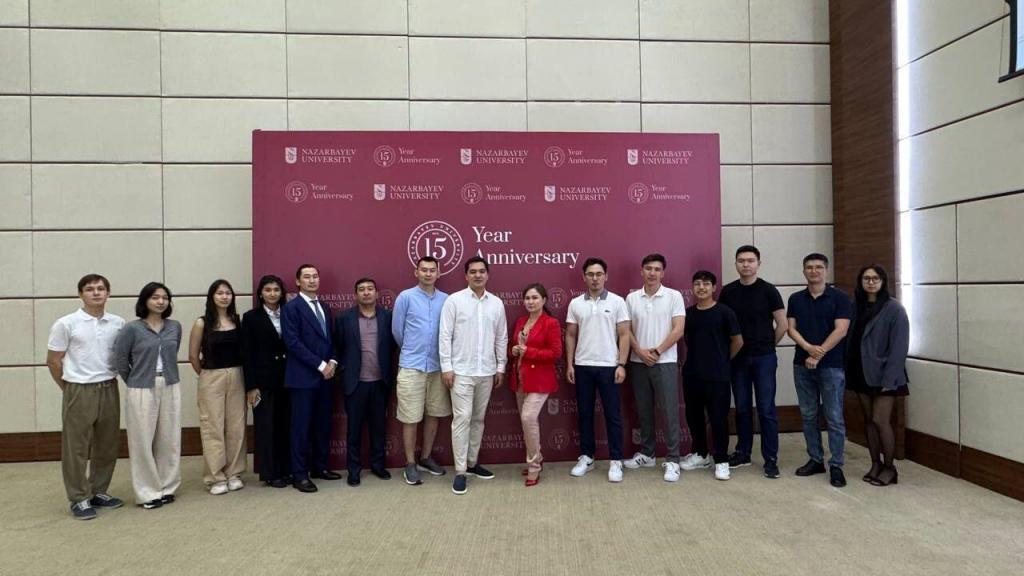
A media tour titled “Smart Tomorrow: From Student Ideas to Global Breakthroughs” was held at Nazarbayev University, where students, researchers, and innovators showcased their projects in ecology, energy, artificial intelligence, and space exploration.
The event was organized by the University’s Office of Sustainable Development.
The highlight of the event was a series of presentations from the Sustainability Living Lab program, which spans 12 universities nationwide. This initiative not only empowers youth to develop innovative solutions but also helps implement them in real-world environments, creating a direct impact on sustainable development.
Featured projects included:
Bulan Bikes — eco-friendly electric bicycles built by students using refurbished Nissan Leaf batteries. The project addresses urban mobility challenges by saving time and costs for students, enhancing efficiency for security and service teams, and reducing carbon footprint. The bikes feature an online monitoring system for real-time status and battery charge tracking. Plans include scaling the project and sharing expertise with other universities.
Watermatic — a fully automated flood protection system for pump stations with remote control capabilities. It eliminates the need for manual reservoir filling and constant supervision. The system ensures uninterrupted irrigation, while digital monitoring promotes more efficient water use.
EcoWare — biodegradable tableware made from crushed wheat. Utilizing natural ingredients such as food-grade dyes, starch, and glycerin, the project produces durable, eco-friendly products that are harmless to the environment. The manufacturing process includes cleaning, mixing, molding, thermal treatment, and quality control. The project is currently patenting its technology and preparing for pilot production.
EcoWoolPellets — granulated fertilizers made from sheep’s wool that improve soil structure, reduce water stress by 30–50%, and decrease the use of chemical inputs in agriculture. This project transforms organic waste into a valuable resource for sustainable farming.
IntelStore — an intelligent cubic storage and order fulfillment system. The robotic technology reduces space usage by up to 75%, speeds up order picking by 3 to 5 times, and minimizes errors. The solution is adaptable for businesses, pharmacies, distribution centers, and industrial facilities.
Whole Genome Project — a large-scale genetic study of the Kazakh population. The biobank contains over 500 complete genomes and serves as a foundation for developing diagnostic panels, pharmacogenetic solutions, and personalized medicine. Research has been ongoing since 2013 with the involvement of the schools of medicine and humanities.
ISSAI (Institute of Smart Systems and Artificial Intelligence) presented a comprehensive AI ecosystem designed to address local needs and linguistic identity, featuring:
- KazLLM — the first large Kazakh-language model with up to 70 billion parameters;
- MangiSoz — a speech recognition and synthesis service with translation capabilities;
- Oylan2 — a multimodal model handling text, sound, and images;
- TilSync — a real-time subtitle generator and simultaneous translation tool;
- Beynele — a multilingual image generator reflecting Kazakh cultural identity;
- Mangitas 01 — a local inference server ensuring technological sovereignty and AI accessibility in Kazakhstan.
Researchers at NU are also applying neural networks and supercomputers to decode cosmic signals, offering new insights into astronomical data and significantly enhancing analysis accuracy.
Thorium energy — unlike traditional uranium, thorium offers several advantages: greater availability, safer operation, lower radioactive waste production, and it cannot be used for military purposes. This project focuses on innovative solutions for Kazakhstan’s low-carbon energy future. Special emphasis is placed on combining thorium reactors with AI and nanotechnology, opening prospects not only in energy but also in early disease diagnostics and improving overall environmental safety.
The event concluded with an informal networking session and dialogue with project authors, providing guests the opportunity to ask questions, test technologies, and discuss pathways for scaling these ideas.
Nazarbayev University supports Kazakhstan’s strategic priorities in sustainable development, digitalization, energy, and medicine. The university fosters an environment where academic research meets practical application, and student ideas become real solutions to pressing societal challenges.