A group of physicists led by NU Assistant Professor Viktor Brus proposed a novel high-performance and radiation-resistant UV-vis-NIR heterojunction photodiode as part of their research project launched in January 2022 with a grant from NU.
Typically, the process of combining different semiconductor materials with unique properties leads to a decrease in the detectivity and response time of heterojunction diodes. NU scientists were able to provide additional functionalities to the heterojunction photodiodes while maintaining and even improving their existing performance characteristics.
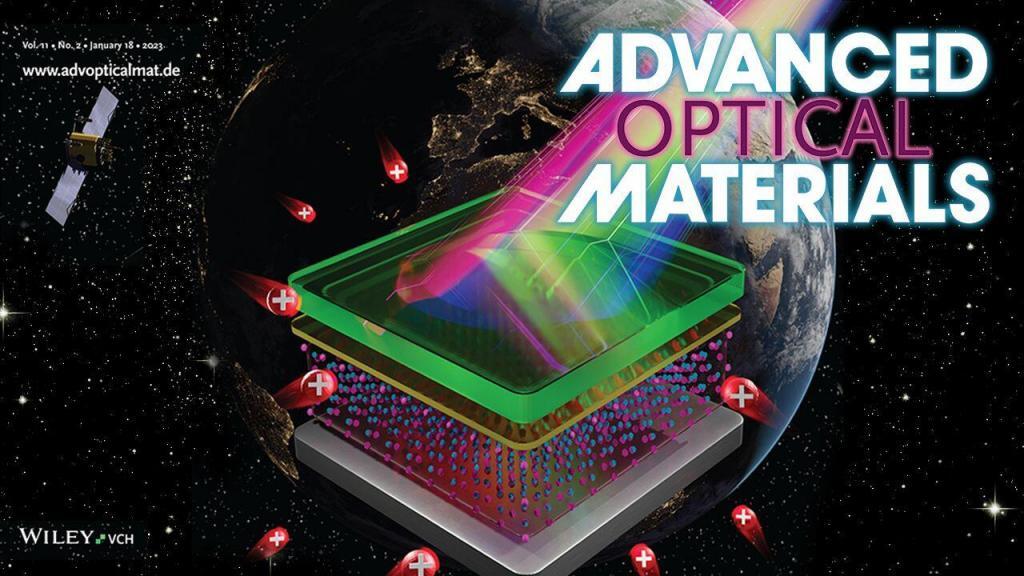
The developed heterojunction photodiodes based on titanium nitride (TiN) ‘window’ layer and cadmium zinc telluride (CdZnTe) photoactive layer demonstrate reliable and long-term operation under the detrimental influence of ionizing radiation making it applicable for use in extreme environments such as space or radioactively contaminated areas.
“Our main contribution is combining optoelectronic materials with known radiation resistance in a novel heterojunction photodiode device structure. So, this device which is based on a titanium nitride ‘window’ layer and cadmium zinc telluride active layer, allows us, first of all, to achieve very high photodiode characteristics; in particular, they outperform their alternatives based on compound semiconductors in terms of response time and specific detectivity. However, as an added feature of this device, we achieved three orders of magnitude (up to 1000 times) higher radiation stability than that of conventional silicon-based counterparts,” NU Assistant Professor Viktor Brus explained.
The added feature of the proposed heterojunction photodiodes is their advanced radiation resistance, which was experimentally tested employing the NU pulse high-current ion accelerator INURA. The accelerator was launched in 2019 within a five-year scientific and technical program between NU and LBNL (UC Berkeley), funded by the Kazakh Ministry of Education and Science. It generates an ion beam of very short duration and high power.
“Here we conduct experiments on the modification of materials for various applications. For the group of Professor Victor Brus, we modified the accelerator to create conditions similar to conditions in space and successfully tested newly developed heterojunction photodiodes. Thus we are able now to test the radiation resistance of materials. I would like to point out that our accelerator has an important feature: its total power consumption is just about 10 kilowatts, but the pulsed power of nanosecond beam is higher than 100 megawatts per square centimeter,” Marat Kaikanov, an NU postdoctoral researcher told.
The research results have been recently published in a prestigious international journal Advanced Optical Materials and highlighted on the journal’s cover image.
Scientists will continue working on improving their heterojunction photodiode concept utilizing a series of different types of novel semiconductor materials and device structures for developing next-generation radiation-resistant optoelectronic and photovoltaic devices.