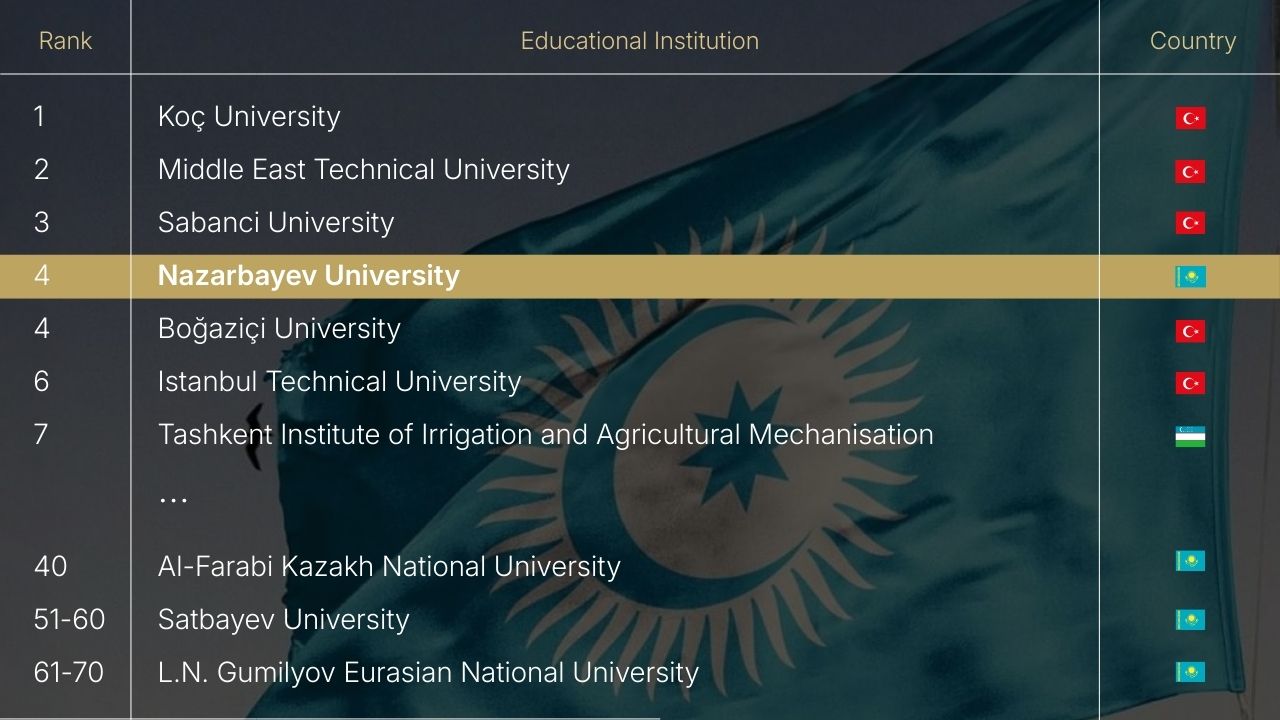
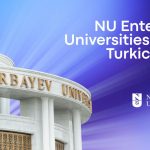
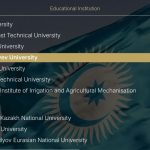
Times Higher Education has published its Central Eurasia University Rankings for the first time, assessing universities across the Turkic world. Nazarbayev University placed fourth among 122 institutions, sharing the position with Boğaziçi University. The pilot ranking is based on results from the World University Rankings 2026. Despite being founded in 2010, NU remains the highest-ranked university in Central Asia among participating Kazakh institutions. It trails only three Turkish universities: Koç University (founded in 1993), Middle East Technical University (founded in 1956) and Sabancı University (founded in 1994).
“This recognition confirms our standing as a leading university in Central Eurasia,” said NU President Waqar Ahmad. “Our vision is to be world class in research, innovation and teaching, while supporting the development of Kazakhstan and the region. Our sharpened strategic focus, strengthened academic leadership and investment in research and innovation, will accelerate our progress towards achieving this vision. We expect the outcomes to be reflected in improved ranking position in the years to come.”
Other Kazakh universities included in the ranking are Al-Farabi Kazakh National University (40th), Satbayev University (grouped 51–60), L.N. Gumilyov Eurasian National University (61–70) and Kazakh State Agrarian Research University (grouped 101+).
While Turkish universities dominate the ranking, Kazakh institutions lead the region in international outlook, measured by the share of international students, faculty, and research publications.
As a leading research institution in Central Asia and the Caucasus, Nazarbayev University expands partnerships with Turkish universities, advances joint interdisciplinary projects and supports academic exchange programs.
Digital technologies represent another area of cooperation. The Institute of Smart Systems and Artificial Intelligence (ISSAI) at Nazarbayev University develops language technologies for Turkic countries. Its MangiSoz 3 platform integrates speech recognition and synthesis, optical character recognition (OCR) and machine translation, supporting 11 languages, including Kazakh, Turkish, Kyrgyz, Uzbek and Azerbaijani. Another product, TilSync, provides simultaneous interpretation and has already been tested in Turkish-language settings.
The pilot ranking includes universities from five member states of the Organization of Turkic States: Azerbaijan, Kazakhstan, Kyrgyzstan, Turkey and Uzbekistan. According to the THE’s compilers, the list of participating countries and institutions may expand in the future, and the publication threshold may be lowered, increasing the number of ranked institutions.
NU’s inclusion among the top universities of the Turkic world strengthens its position as one of the region’s key research centers and reflects growing competition among Central Eurasian universities on the global stage.