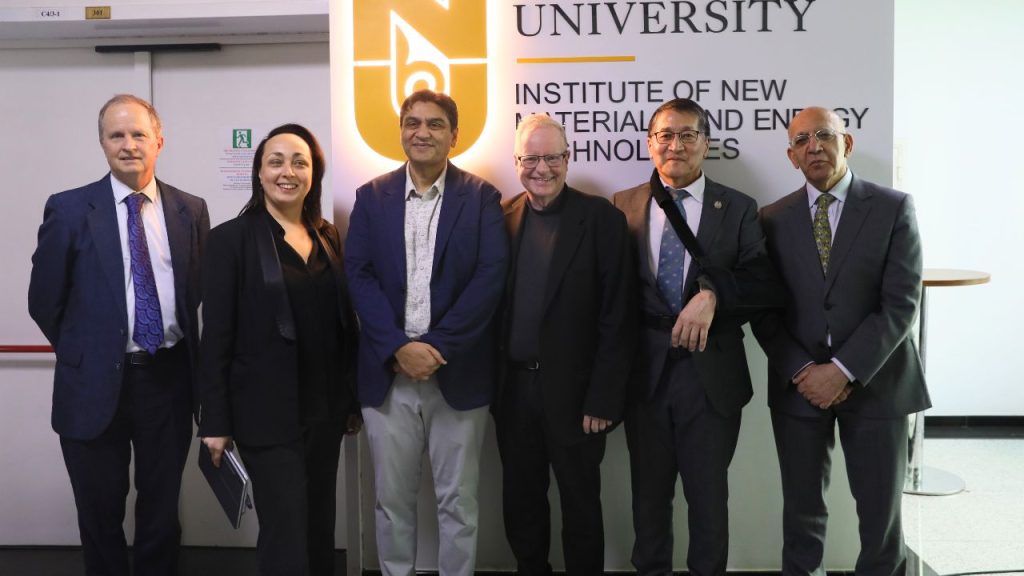
Nazarbayev University has established the Institute of New Materials and Energy Technologies (INMET) in partnership with the National Academy of Sciences of Kazakhstan. The institute will focus on applied research in advanced materials and energy systems, with an emphasis on technology development, commercialization, and national energy priorities. It will also support Kazakhstan’s goal of reaching carbon neutrality by 2060 and provide expert advice on national energy projects.
The institute will bring together scientists, engineers, and industry partners to work on areas such as nuclear and renewable and nuclear energy, environmental and sustainable energy systems, energy storage systems, energy conducting materials and digital energy technologies along all areas.
“In creating INMET, we are strengthening our capacity in sustainability, energy, and advanced materials research,” said Professor Waqar Ahmad, president of Nazarbayev University. “The institute aligns our research agenda with Kazakhstan’s long-term development goals.”
Academician Akhilbek Kurishbaev, President of the National Academy of Sciences of the Republic of Kazakhstan, said that one of the Academy’s major energy initiatives will be carried out in partnership with the new institute. “Advanced materials and energy technologies underpin the modernization of the energy sector, industry, transportation and environmental infrastructure. These fields are central to strengthening the country’s technological independence and building a foundation for sustainable economic growth. In this context, the establishment of the institute carries strategic significance,” he noted.
The institute was created by transforming the former Center of Energy and Advanced Materials at National Laboratory Astana and expanding its infrastructure for prototyping and commercialization. INMET now includes seven laboratories and research centers, among them the Center for Digital Modelling and AI in Energy and the Center for Nuclear Research.
Dedicated facilities for prototyping and commercialization will be established within industrial collaboration to foster technology transfer. According to INMET’s General Director, Аcademician and NU Professor Zhumabay Bakenov, the institute is designed to work closely with industry. “We aim to solve practical business challenges, improve existing technologies and develop new products,” he said.
The research team has already achieved several results. They installed a pilot production line for pouch cells and prismatic lithium-ion battery cells and successfully tested the assembled battery module in an electrical vehicle. Researchers also built a pilot hydrogen generator and developed a technology to produce pharmaceutical materials from agricultural waste such as rice husks and corn cobs, applying principles of green chemistry. In addition, teams are developing data-driven models and digital tools to accelerate innovation in materials and energy systems.
Beyond research, the institute will train students and young scientists in energy and materials science. In the long term, INMET aims to become an international center by attracting students and researchers from Kazakhstan and abroad.
In August 2026, INMET will host the 14th International Conference on Nanomaterials and Advanced Energy Storage Systems (INESS-2026), where researchers and industry representatives will discuss the institute’s future direction and cooperation opportunities.