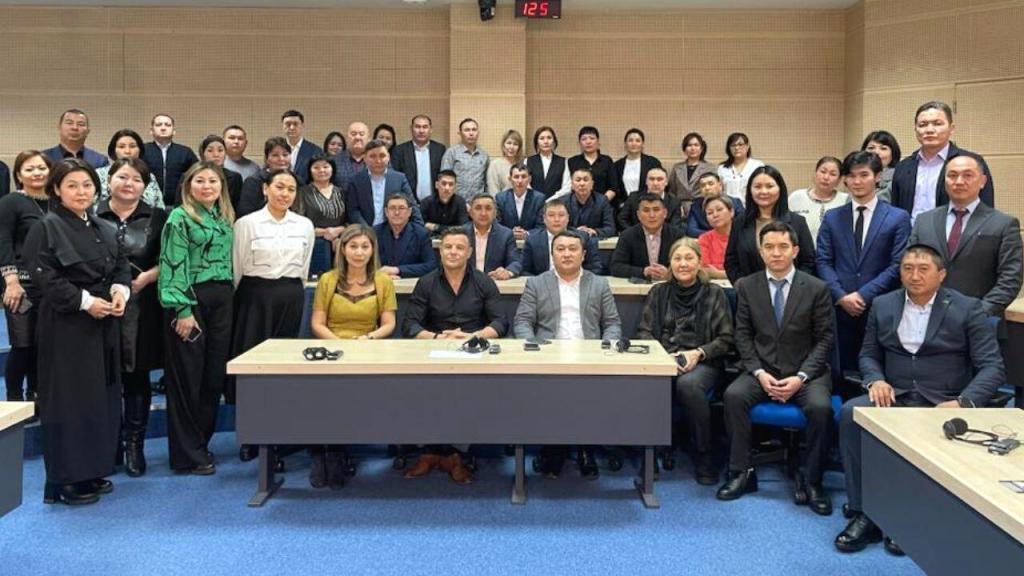
The Kazakh National Testing Center’s representatives and its regional branches’ directors visited the NU Graduate School of Education. During the meeting, Professor Michael Mаcoelle, Vice-dean for Research of NUGSE, spoke about the School’s main activities, and Balzhan Bliskeldinova, the Administrative Director of the CPS covered in detail the process of conducting entrance exams to NU.
The guests expressed a great interest in the research result presented by Matthew Courtney, NU GSE Professor, who specializes in educational measurements. Dr. Courtney analyzed the data collected by the Kazakh Ministry of Education, now the Ministry of Enlightenment, based on the results of testing the updated curriculum in schools from 2015 to 2019. As part of its research, the Ministry monitored the numeracy and literacy skills of thousands of primary school children enrolled in the old traditional curriculum and the newly updated curriculum.
A study of these data by Dr. Matthew Courtney showed that children are academically much better prepared to enter school. Three main factors positively influence the level of literacy and numeracy before children enter school: attending kindergarten for a longer time, raising children by more educated mothers, and attending an art program, Dr. Courtney believes.
Among the results obtained, there is another interesting outcome: the different levels of admission, demographic characteristics of the child, and his preschool experience had nothing to do with the “pace of development” during the first five years of schooling. This suggests that teachers provide an equivalent level of educational support to all students in Kazakhstan.
“However, my analysis of these data also showed that children studying according to the updated curriculum, as a rule, study much faster than their peers studying according to the traditional curriculum, and that the positive effect of the updated curriculum was equally felt by both Kazakh-speaking and Russian-speaking children, which is also important,” – Dr. Courtney noted.
NU GSE alumnus Daniyar Kerey-Kenzhetai, who made an invaluable contribution to this research, presented his part.
Representatives of the Kazakh National Testing Center noted that the information shared by Professor Courtney and his unique experience in educational research is of great interest and practically useful in the work of the Center.