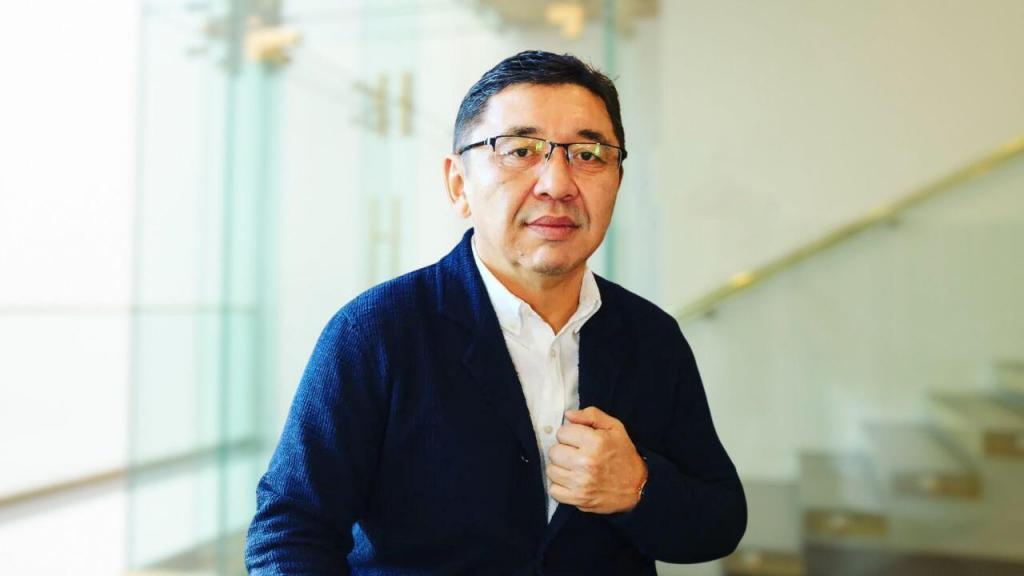
His dissertation is devoted to researching practices that promote the inclusion of adult students with disabilities in Kazakhstan’s professional and technical education system. Within his doctoral program, Arman Assanbayev received a research internship in Cambridge, USA. He studied the American experience of training people with special needs for in-demand professions in the labor market. Arman has a passion for history and philosophy.
Arman, please tell us about your professional and academic experience?
My primary education is related to economics. I graduated from the Kazakh National Pedagogical University named after Abay with a degree in global economics and worked as an economist for a while. I also worked abroad for an Indian company Tata Group and ran my own business. After a while, I started a teaching career at Kunayev College, where I was involved in volunteer work with the students. And when the National Academic Library offered me the chance to teach English classes to totally blind people on weekends, I agreed. At that time, I didn’t even know that it was inclusive education. This activity fascinated me. When NU opened a master’s program, “Leadership in Education” and the direction “Inclusive Education,” I applied. After graduating from the master’s program, I continued researching the issue. Apparently, my background clicked regarding my doctoral dissertation topic, which was about inclusion in vocational education and training (TVET).
How did your doctoral studies go?
The program was designed for three and a half years, but I managed to fit in five years, including my thesis defense and graduation in six months. In the early years, the doctoral program was intense, we had a lot of academic classes, so there was no time for the dissertation. As part of the program, I studied for one semester at the University of Cambridge. My supervisor was the Dean of the Cambridge School of Education and was very knowledgeable about the TVET system. My dissertation supervisor at NU was Tsediso Makoelle, Associate Professor specializing in inclusive education.
What did you discover while studying this issue? What is the attitude to inclusive education in Kazakhstan in the vocational sphere?
When some people hear about inclusive education, they think its development requires significant finances and equipment. Of course, we need funds, but it turns out that they do not play an important role. More important is the practice of teaching how to include adults in TVET, especially people with disabilities. This is an exciting point because, as in many countries, we have a massification of higher education, and many people try to go to universities, especially adults. Getting people with disabilities into the TVET system takes a lot of work. As research shows, many adults drop out after a while, and some people do not find jobs when they graduate. If an adult comes to college, it’s three years of study, but they have a family to feed, so adults leave. Also, our employers are not involved in the training process.
What solution or recommendations do you have?
World experience shows such a form of interaction, a form of training as an apprenticeship. In this model, students do not study many subjects. Still, they learn the skill on the employer’s premises for some time and simultaneously explore the theory. For example, this model is used in England and Australia, and students do not study subjects such as history or geography. While learning, they gain job skills and have the opportunity to earn money. For example, in the U.S., employers are involved in training and developing curricula and teaching classes. For the U.S. government grant, I had a chance to work at a training center and learn how they teach.
What is another feature of Western practice in promoting inclusion in vocational education?
First, teaching should focus on students’ needs so that students with disabilities are included in society. What do I mean by that? For example, students should learn from each other through collaborative work and projects. At the same time, teamwork is essential, so it did not turn out that classmates of the student with special needs felt sorry for him/her and answered for him/her to get a good score.
In addition, colleges in Western countries, for example, keep in touch with their graduates even after they are employed. Moreover, they help them stay in the labor market. They even have a motto “the first thing is to get a job, and the second thing is to remain in the position.
What can you tell us about the process of working on your dissertation?
First, working on a dissertation is not a job but a lifestyle. I devoted myself entirely to writing my dissertation. I developed the habit of getting up every day at 6 am and saving time for my research work until 8 am. And this continued throughout the entire period of my studies. Two hours a day of focused work is 60 hours a month and 720 hours of concentrated work a year. The night before, I would create a Word document and write a few starter sentences so I could continue without hesitation in the morning.
What do you plan to do soon?
I intend to continue doing research as a postdoctoral fellow at NU. For more than a year, we have been analyzing the situation and developing policy recommendations to effectively promote young people who do not study or work anywhere. This research is part of the USAID international agency program. I would also like to teach and work at one of Kazakhstan’s universities.
What would you wish for future doctoral students?
It is crucial to have friendships within the group during the training process. While I was a doctoral student, I felt the most significant support from my classmates. In addition, it is vital to be careful in choosing a thesis advisor; they should always be available. And it is essential to remember that the best dissertation is a completed dissertation!