“Last year, NU entered the top 30% of research-intensive universities worldwide according to the prestigious Times Higher Education ranking. This year, we entered the top 11% of universities in Asia and almost got into the top 100 young universities globally, all within just 14 years of operation. We are also working towards obtaining institutional accreditation from the Quality Assurance Agency (QAA),” said Acting President Dr. Ilesanmi Adesida.
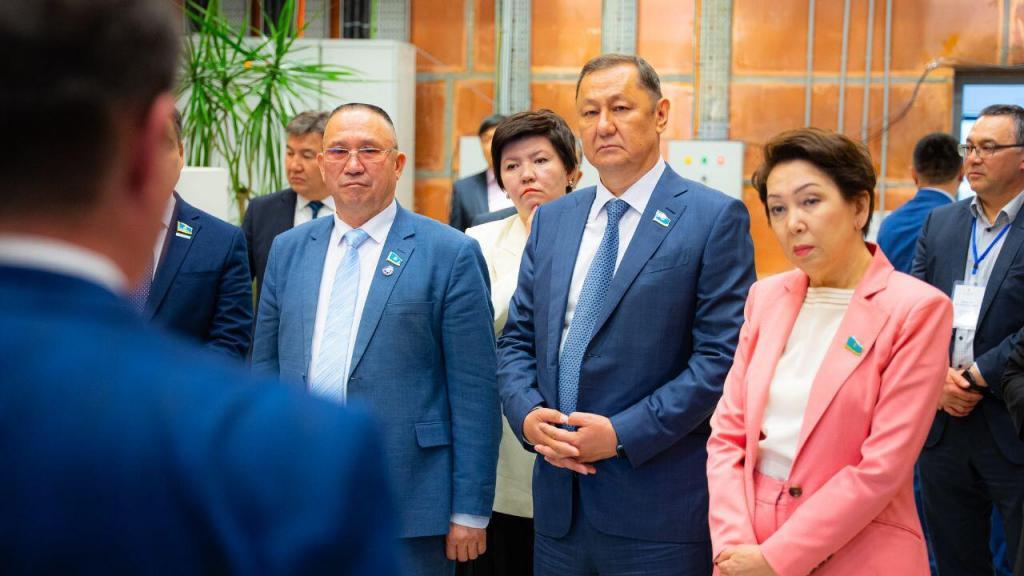
During the visit, the Parliament members learned about NU, saw the campus master plan, and toured highly functional laboratories, including for genomic and personalized medicine, a pulse accelerator, electron microscopy, and the Center for Medical Robotics and Research. They also learned about the innovations produced at the Institute of Intelligent Systems and Artificial Intelligence (ISSAI).
“The scientific innovations here are impressive. It is crucial to apply the university’s and NIS experience to the broader education and science system. We will work to preserve and strengthen the potential of these educational institutions,” highlighted Tatyana Savelieva, Mazhilis Finance and Budget Committee’s Secretary.
Young scientists at NU showcased their research projects such as genome studies of the Kazakh population and their predisposition to various diseases, and a targeted delivery method for cancer drugs that affects only the diseased areas. The visitors paid special attention to the exoskeleton for rehabilitating patients with motor dysfunctions developed at the Center for Medical Robotics and Research.
“At our Center, we develop robots for surgery and rehabilitation and use AI-based computational pathology for cancer diagnostics. Thanks to the World Bank grants, NU has created rehabilitation robots used to treat people with disabilities,” said Aibek Niyetkaliyev, one of the scientists working on the exoskeleton.
Next Mazhilis members learned about the i-NURA (Nazarbayev University’s Research Accelerator) project. “This accelerator provides ultra-fast energy impacts on materials. It was created in collaboration with the Lawrence Berkeley National Laboratory (USA) and other partners and launched in 2019. It enables advanced research to enhance the efficiency of materials for the space and nuclear industries,” noted NU researcher Dr. Marat Kaikanov.
The politicians also explored the work of powerful microscopes used to study nano-objects. Researchers from ISSAI demonstrated the latest AI developments, including the first automatic speech recognition (ASR) model for the Kazakh language and the first Kazakh text-to-speech corpus (KazakhTTS). They also showcased multilingual speech recognition for Turkic languages, two-way machine translation into four languages, and other AI projects.
“For the first time since the university’s establishment, members of Parliament visited NU. I was very impressed by the scientific work here. Indeed, the best minds of Kazakhstan, and those who have worked abroad, have been brought back to contribute to our country. Some of the innovations here do not exist anywhere else in the world. It is vital to continue the trend of funding NU,” noted Deputy Chairman of the Mazhilis Daniya Yespayeva.
The management and scientists of NU thanked the parliamentarians for their attention, assuring them of continued high-quality integration with the global scientific and educational community, and close collaboration with Kazakhstan’s universities to enhance the domestic education system and scientific potential.