Martin Hairer at ISAAC 2025: AI Does Not Generate New Ideas
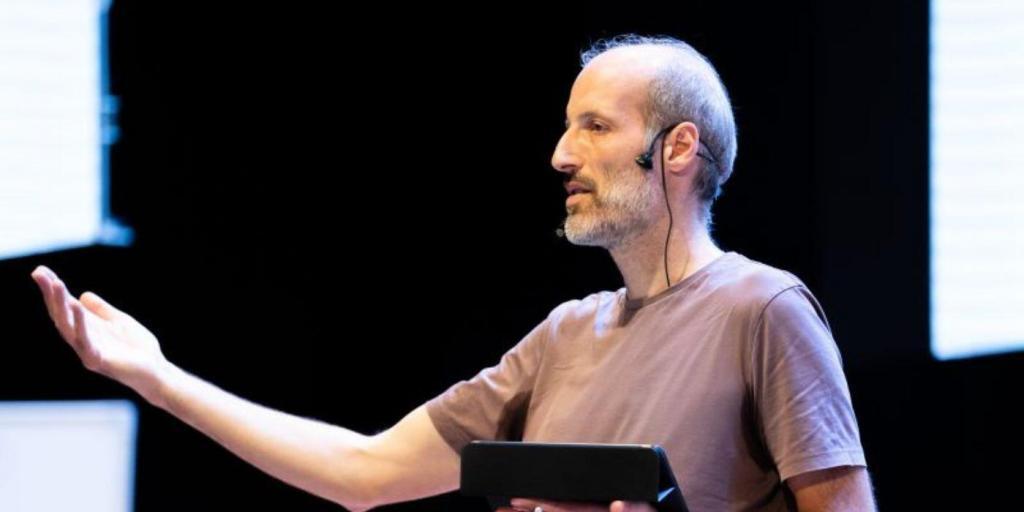
One of the prominent guests of the 15th International ISAAC Congress, organized by NU and dedicated to the university’s 15th anniversary, was Martin Hairer – an Austrian-British mathematician, Fields Medalist, and professor at EPFL in Switzerland.
Hairer is known for his work on stochastic partial differential equations – the mathematics of how randomness affects complex systems. His research helps explain unpredictable phenomena like turbulent air, spreading water droplets, or milk swirling into coffee. When randomness overwhelms these systems, classical methods fail; Hairer developed new tools to make sense of such chaos, earning him the Fields Medal in 2014. In an interview, he shared his views on AI, logic, and mathematical thinking.
Why AI doesn’t create new ideas?
Because the way AI works – it does not create knowledge. It takes every piece of knowledge from the Internet. The way it works – it tries to find what the most plausible answer is based on the dataset. But it does not create new ideas. It sort of makes things up because it makes things plausible. It will give you a list of references. Let’s say I ask, who worked on this famous problem? And it will give you a list of references, and then one of them does not actually exist, but it will all look plausible.
I do not address this issue in my course. If my students want to use AI, I don’t mind. And then I have oral examinations where they can’t use AI – it is where they have to actually discuss things with me.
Are there things in life that are beyond your mathematical understanding?
Many things in life are not amenable to a mathematical type of understanding. In mathematics, it’s not necessarily difficult to have a mathematical understanding – what’s extremely hard, or sometimes unknown, is how to even ask a mathematical question or how to properly formulate it into a mathematical problem.
To turn a question into a mathematical problem, you need to phrase it very precisely. But most of the concepts we use every day in language aren’t very precise. In many cases, part of something fits the concept, part does not, and there’s often a grey area. So, many things in life aren’t even suitable for mathematical understanding or analysis.
Is there a structure behind everything?
No, not necessarily. Take human interactions – they’re not very amenable to mathematical modeling. You can model the behavior of a crowd, but not an individual human being. There’s no mathematical equation that can tell you whether you’re going to fall in love with someone. But if you have hundreds or thousands of people, a crowd, then you can predict what the crowd is likely to do.
How important are soft skills in mathematics?
Part of mathematics – if you understand something, it’s very gratifying. But what’s the point if you can’t explain it? Part of mathematics is about talking to people, explaining ideas, and finding out what they understood.
Your work deals with how randomness appears in everyday things. What does randomness mean in mathematics – and why is it important?
The actual behavior — if I add milk to this coffee and you see how it mixes: this is already random. The air has lots of little molecules of oxygen, nitrogen: they bounce around like billiard balls and move in a random way. If you want to understand how air moves around, you need to start with a random description of all these little balls, how they move, and in the end find something that really describes the wind and how things move.
Will AI resolve most of the scientific problems of the century?
We will see. I don’t really believe that. There has been huge success with AI – the work with AlphaFold (Editor’s note: an AI that predicts protein structures, awarded the 2023 Chemistry Nobel Prize). It is very useful, absolutely fantastic work, but it doesn’t provide real understanding. In mathematics, we really try to understand things.
Take self-driving cars. Tesla has been saying for 10 years they will have fully self-driving cars next year. Their cars work well, but they aren’t fully autonomous yet. And here’s the problem: you don’t really understand how they work. For a car, if you make a mistake… a person dies, a car crash. If you don’t understand how these systems work, yet you put your life in their hands, systems that work 99.99% of the time but you don’t know why – mathematicians are unhappy with that. We want to understand things.
Would you like to live in a country where all the leaders are mathematicians?
(…) By and large, mathematicians tend to keep you honest. There’s a tradition of intellectual honesty and admitting mistakes. In mathematics, a proof is either right or wrong. Even if someone comes up with something wrong, others will point it out. There’s a habit of accepting errors and carefully evaluating others’ arguments. I think this is useful.
On the other hand, to be a politician you need many other skills that have nothing to do with mathematics: communication, inspiring people, and more. Some can do both, but generally, mathematics isn’t the most important skill.
Being able to understand numbers is essential. You don’t have to be a great mathematician, but having some education in statistics is useful for policymakers. You often get statistics that seem contradictory, and then you need to make sense of them. From what you hear from politicians, many really should have a better understanding of numbers.
Thank you for this interview.
The ISAAC International Congress is being held in Central Asia for the first time. It is the largest event in the world of mathematics. Over 700 leading scientists from 70 countries have come to Kazakhstan.