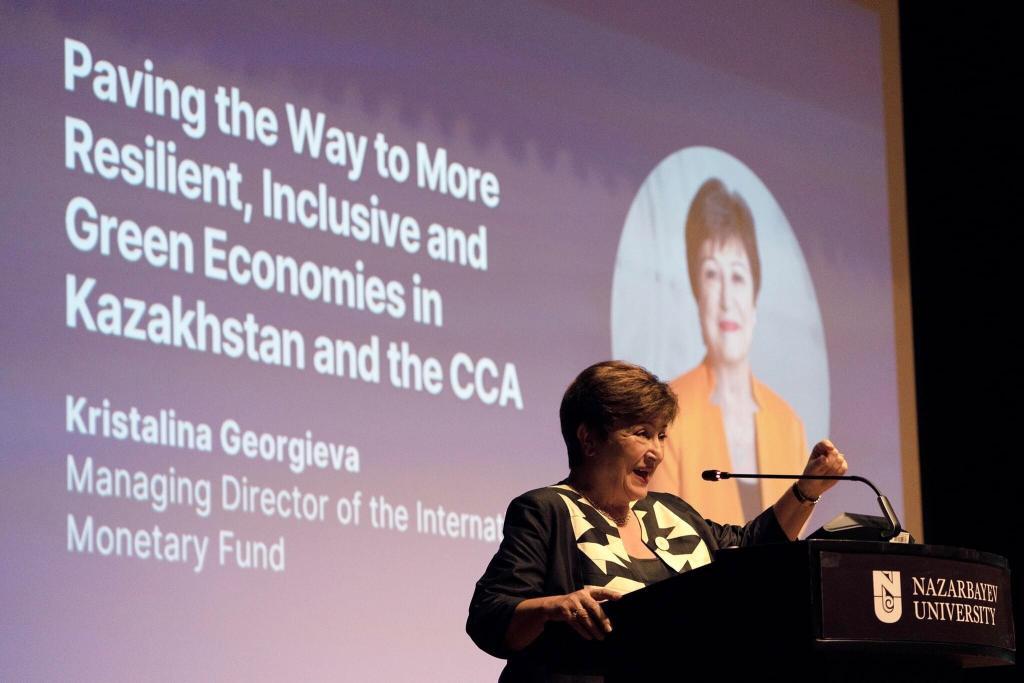
On June 8, 2023, Kristalina Georgieva, Managing Director of the International Monetary Fund (IMF), had a compelling, honest and lively discussion with the Kazakh youth at NU, moderated by President Shigeo Katsu. The conversation focused on paving the way to more resilient, inclusive, and greener economies in Central Asia and the Caucasus (CCA).
Kristalina Georgieva highlighted the significant leap and transition the countries in the region have made since becoming independent republics in the early 1990s, commending the appetite for reform in the region at the time, which led to accelerated growth in the region.
“You went through dramatic transitions in the early 90s, just like we did in Bulgaria where I was born. I know what it takes for people to live through these reforms. The appetite for reforms was there, growth was strong,” Georgieva said, adding that, however, now the appetite for reforms has weakened and growth in the region has slowed down. “This is not good especially when we have shock after shock, like the pandemic, war, and living standards crises,” Managing Director explained. She mentioned the need to create new momentum for reform for the countries in the region to be able to withstand the external shocks, focusing on three major areas: inclusion, private sector development, and mitigating the effects of the climate change.
The world economy has been picking up rapidly after the COVID-19 pandemic, but the growth stalled after the Russian war against Ukraine broke out in February 2022. The global growth rate was at 6.1% in 2021, at 3.4% in 2022, and slowed to 2.8% in 2023. The forecast for next year is “gloomier.” Even though the pace of growth in Central Asia is higher now, MD Georgieva believes it is still not up to its potential. Serious structural reforms are essential to unleash the region’s true potential.
“Structural reforms in this region can add between 6 and 7% of GDP on an annual basis. This is a massive injection in prosperity for people in this region and obviously, one that should be pursued. So how do we propose these reforms to be prioritized? First, very important for any country, but particularly important for economies still catching up – to invest in people. This is the best investment governments can make because the ability to adjust to a changing structure of the world economy relies on the adaptability of people with your skills, your ability to learn, to relearn, to develop further, to step forward as opportunities arise, to be the captain of your own destiny,” she elaborated.
The IMF head emphasized the importance of accelerating the transition to low-carbon economies. The Central Asian countries suffer the impact of the climate crisis with local annual temperature growth surpassing the global temperature rise by 2.5 times. She has encouraged the young people to urge the governments in the region to create significant incentives for green and sustainable energy production and conservation; invest in increasing interconnectivity, interdependence, and higher integration between the countries of Central Asia, as this will create a greater buffer against forecasted dramatic water shortage in the future.
“I apologize to you that we messed it up. We knew about the problem and did not do enough. You will hold the brunt of the problem,” confessed the 69-year-old world leader while addressing the youth. She encouraged young people to take green jobs over careers in traditional energy, manufacturing and processing sectors.
“Whenever there is a debt crisis in the world, the IMF leader will be there, whenever issues with the balance of payment and macroeconomic problems arise, she will be there. But what you may not know is that when we talk about climate change, green growth and sustainable development, well, Kristalina will also be there,” President Katsu commended Managing Director’s passion for climate action.
After speeches, Kristalina Georgieva and President Shigeo Katsu took questions from the young audience, providing a platform for meaningful dialogue and inspiration for the younger generation to actively engage in creating resilient, inclusive, and greener economies in the CCA region.
As the Managing Director of the IMF, Georgieva plays a critical role in shaping global economic policies and fostering cooperation among nations. Prior to her current position, she served as the CEO of the World Bank, where she spearheaded initiatives to address pressing global issues, including the Euro Area debt crisis and the 2015 refugee crisis. Her remarkable career in public service spans various high-level positions, including European Commission Vice President for Budget and Human Resources and Commissioner for International Cooperation, Humanitarian Aid, and Crisis Response.
Born in Sofia, Bulgaria, Ms. Georgieva holds a Ph.D. in Economic Science and an M.A. in Political Economy and Sociology from the University of National and World Economy, Sofia. Her exceptional leadership and dedication have been recognized with numerous accolades, including being named “European of the Year” and “Commissioner of the Year” in 2010. She was also named one of “the 100 most influential people of 2020” by Times magazine, and one of the world’s 100 most powerful women by Forbes in 2022.
Photo credit: IMF