These solutions might help the capital city to mitigate the risk of flooding and citizens’ needs in drinking water. The joint three-year German-Kazakhstani TERESA project funded by the German Federal Ministry of Education and Research (BMBF) ended recently. Now, scientists plan to test their scenarios in actual metropolitan climate conditions.
At the NU workshop, Dr. Catalin Stefan from the Dresden University of Technology (Dresden, Germany) and Katharina Fuchs, engineer from the Institute for Technical and Scientific Hydrology (Hannover, Germany) showcased some results of a built model for natural retention and infiltration of surface water. Nurlan Óndas, PhD student at Dresden University of Technology provided data obtained during tests on the research field. Also, Lothar Fuchs, CEO of the Institute of Scientific and Technical Hydrology, participated in the workshop.
“Astana has expanded over 20 years fantastically, and we realize that this expansion brings a lot of challenges, such as drinking water supply and green water management. Astana has a special status as the second coldest capital city in the world, and most of the rainfall is spread over the year, but we have a special situation in spring when there is too much water. At the same time, a lot of water is needed in the summer. One of the project’s main idea was how to capture, retain and store water from the spring and use it for different purposes, make it available for the green areas, city irrigation and so on,” says Dr. Catalin Stefan.
Scientists have proposed multifunctional solutions to help reduce stormwater runoff, increase groundwater recharge. Based on numerical modelling tools, they tried to understand how to better implement long-established sustainable urban drainage technologies (SUDS) and managed aquifer recharge (MAR) systems that are used in many countries worldwide.
“We used a range of simulation models to try to understand the water balance of the city and design solutions for management. We look at the future and what the resilience of the city will be like in extreme situations. Simulation models are considered business scenarios where we implement government development plans, and we also suggest blue-green infrastructure, which combines green areas for water balance and blue infrastructure, which means storing this water in different parts of the city to be available during summer. The simulation that we run shows that it is possible to retain almost half of the water that comes from the rain; we can retain it in the city and not lose it. We call it a resource but not waste water. The second part of the simulation focused on the impact of the solutions on groundwater, and we found out that the increasing groundwater levels are deficient, so there is no rising risk,” explains Dr. Catalin Stefan.
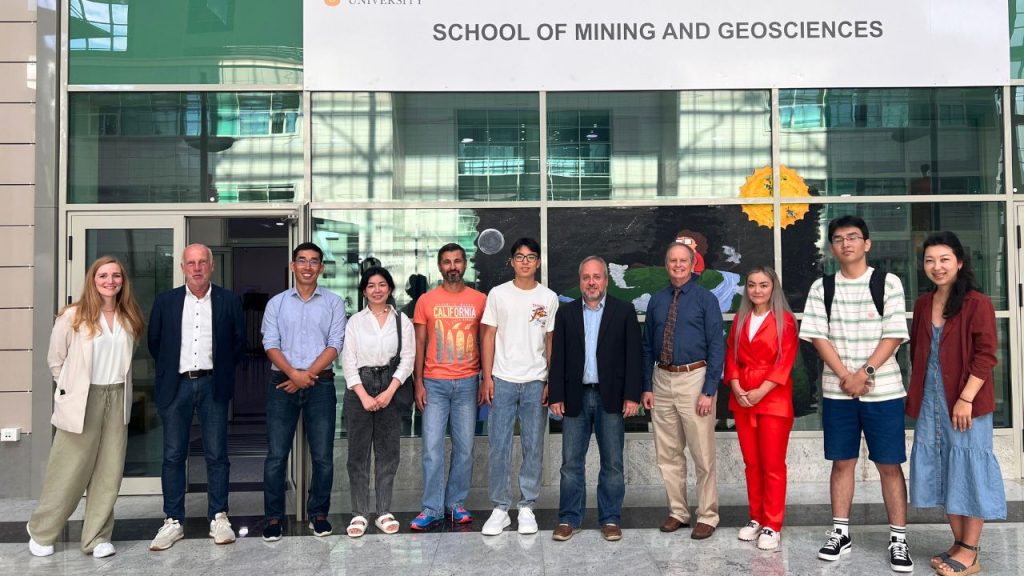
NU scientists, including postdoctoral fellows and students from the NU School of Mining and Geosciences, have an excellent opportunity to participate in the project, conduct tests with seasoned scientists, and monitor groundwater at the university’s experimental site.
“Several NU students took part in some of the research at campus. They studied hydrogeological aspects, which are very important in modelling different precipitation scenarios and their impact on the area. NU is close to the Small Taldykol area, a group of lakes where natural processes occur, which is important to consider in planning. Its proximity to the city, which is actively developing, also plays a significant role,” says Marzhan Baigaliyeva, a postdoctoral fellow at NU’s School of Mining and Geosciences.
Integration of new approaches to water management in Astana can help mitigate the constant problems associated with extreme precipitation and dry seasons in the future. Marzhan Baigaliyeva thinks we should try to implement German solutions on Astana soil.
“Colleagues from Germany offer green solutions in urban design. What do they provide? German solutions will help retain water during snowmelt. This set of solutions includes green roofs, special green spaces, and trenches (or ditches) equipped with certain materials to retain water, taking into account the area’s topography. Now, the German part of the project has been completed, and we at NU, in cooperation with German scientists, want to continue this project, promote it, and implement it,” highlights the scientist.
Over the following years, researchers will make observations and gather data on groundwater changes and meteorology. They are considering several sites on Astana’s left bank to test the German system in the city’s natural conditions. Marzhan Baigaliyeva believes the project may require the support of the Ministry of Water Resources and Irrigation and the Astana Akimat.