She is now an Аssistant professor at the NU School of Engineering and Digital Sciences. Her team is developing microfluidic devices for growing cell cultures. They created the prototype chip to mimic the environment of liver cells in the lab. The professor also talked about research on developing another organ with a lung-on-a-chip device.
Can you please tell us about your educational and professional background?
My educational background is in the engineering field. I obtained my BSc in Engineering Physics and MSc in Electrical and Computer Engineering from the University of Illinois, USA. Then I went on to study for Ph.D. at University College London and did my Ph.D. research in the microfluidics field with applications in the biomedical field. Having started doing research in my undergraduate years, I have always been interested in applying engineering skills for solving problems in the biomedical field. Therefore, my professional career research focus has always been on bio-related topics.
Can you please tell us about your current research project?
My research project is at the junction of several fields such as engineering, biomedical sciences, and natural sciences. Currently, I hold two projects funded by the Ministry of Education and Sciences and NU on the development of microfluidic devices. Microfluidic devices are platforms made of biocompatible material that have microchannels in them and are widely used for different applications such as diagnostics, the pharmaceutical industry, sensing, bioelectronics, etc. My focus is to develop such microfluidic devices that can be used for culturing cell culture to recapitulate the human organ environment in laboratory conditions. Microchannels that are in these chips allow growing cells in dynamic conditions, which better emulates the actual environment that is in the human body. By that, these platforms can better predict the toxicity of drug compounds and eliminate them from drug development by saving costs and time required, and potentially the number of animals used in the testing pipeline.
What are your key research findings?
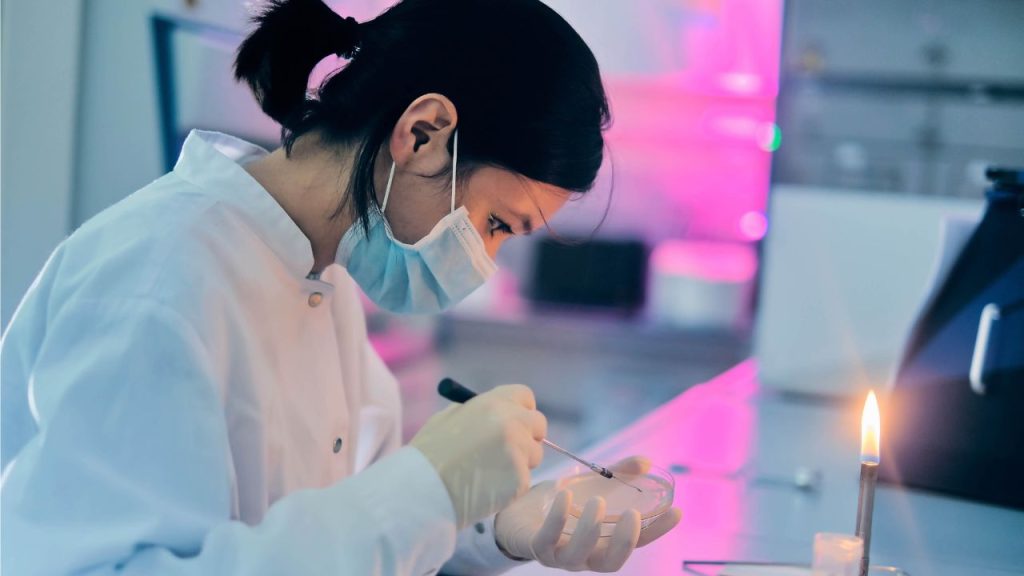
During the year and a half of laboratory work, my team was able to develop a prototype microfluidic device for mimicking the liver cell environment in laboratory conditions. The device is comprised of a microchannel and is made of biocompatible polymer fabricated through a rapid prototyping technique. The device named “liver-on-a-chip” was seeded with liver cells, and we were able to grow the cells in the device under continuous flow for more than 24 hours. Results showed that liver cells were growing at the same or better rate in comparison with cells grown on traditional platforms. The key findings of this research were published in high-impact journals. Currently, we are working on improving and evaluating certain drug compounds on a more optimized version of this microfluidic device. Another main research direction and our main findings are being realized in the framework of an MES grant that is supporting the development of a microfluidic device for emulating the human lung environment in the lab through a “lung-on-a-chip” device. Within this project, so far my team was able to develop a novel membrane that will be used to mimicking the alveoli-capillary barrier membrane that is present in the human lungs. This membrane plays a key role in oxygen and gas exchange in our respiratory system. Therefore, recreating this membrane’s environment through our microfluidic devices would allow us to test toxic compounds that humans breathe in, aerosols, and inhaled drug compounds.
Why did you choose to join NU?
My professional career started at NU after my graduate studies, and I am very grateful to this University for the many opportunities that it has given me throughout my path. I chose NU and decided to stay with NU for several reasons. When I first joined NU as a teaching assistant after my MSc, NU allowed me to obtain the necessary skills in teaching and, at the same time, allowed me to grow my research skills. Additionally, after Ph.D. I decided to come back as a postdoctoral scholar since I had the opportunity to develop my own research and have seed funding to start it off. To note, such opportunities for postdoctoral scholars are very rare worldwide. Therefore, it was a definite yes for me. Later, with the constant support of the University, my proposals and grant applications were successful, and I was able to establish my group and grow my research further.
What are your future plans?
I realy enjoy my research field and working with colleagues and students at our University. Therefore, my plan so far is to continue the same way and contribute to society through education, knowledge, and mentorship.