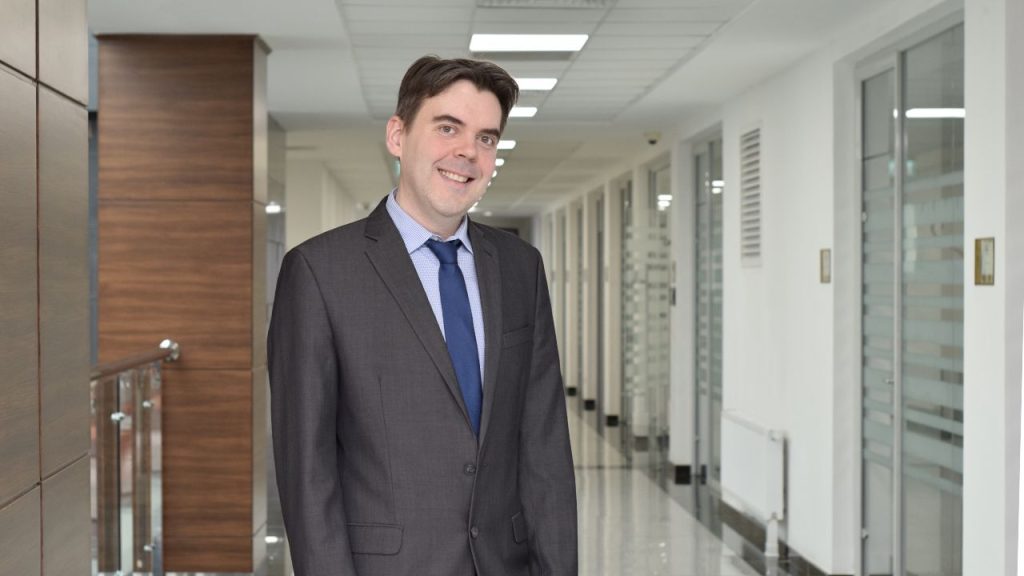
A new guest of “Galym-Galam” rubric is Dr. David De Remer joined NU GSB in 2020 as an Assistant Professor of Economics. He received his Ph.D. in Economics from Columbia University, and he also holds a Master’s degree in Statistics and Bachelor’s degree in Applied Mathematics from Harvard University.
Can you please tell us about your educational and professional background?
I earned my Ph.D. in Economics from Columbia University, which has a long tradition of pushing the frontiers of research in international economics. After my Ph.D., I was a Marie Curie Fellow at Université libre de Bruxelles in Belgium as part of an interdisciplinary research group in economics and international economic law. My subsequent academic employment was with the Hungarian Academy of Sciences in Budapest, where most importantly, I met my future wife.
My next research job was at the Hungarian Academy of Sciences in Budapest, where, importantly, I met my future wife. At the time, she was head of the financial department of a large international company for Central and Eastern Europe.
Other academic positions before I joined NUGSB in January 2020 were with Northeastern University in Boston and the International School of Economics of Kazakh-British Technical University (ISE-KBTU) in Almaty. All these experiences have been formative to my success as a researcher and instructor of international economics.
Going back further, I completed my undergraduate studies at Harvard University in Applied Mathematics and earned a Master’s in Statistics. Each degree provided firm foundations for a career in economics. Prior to my Ph.D., I worked in the research department of the Federal Reserve Bank of Boston. Working at a central bank provided me with valuable experience to share with our full-time MBA students in my Macroeconomics course and our MSc Finance students launching careers with the National Bank of Kazakhstan.
Сan you please tell us about your current research project?
Presently I am researching economic consequences of air pollution in Almaty. Air pollution not only adversely affects long-term health outcomes but also distorts short-term decisions. These distortions manifest in criminal activity, even in low-pollution environments like the modern US or UK. My KBTU co-author Birzhan Batkeyev and I are focusing on how air pollution could impact an emerging market with much higher pollution and at a distinct stage of economic development.
Winds blowing clean air from the Tian Shan mountains and the atmospheric inversions that trap dirty air in the city are suitable natural experiments for disentangling causal effects of pollution on crime. Finding suitable approaches to answer causal questions using observational data is essential to applied economics. The path-breaking contributions in using natural experiments to distinguish causation from correlation are what earned the Nobel Prize for Economics in 2021.
This environmental economics project is noticeably distinct from my usual focus on international economics, but the topic was personal, given the air pollution I observed and inhaled while living in Almaty. Not to mention, I once had my smartphone forced out of hands while texting one night on Tole Bi Street four years ago. The rally authorized against air pollution in Almaty in February 2022 shows how many in Kazakhstan consider cleaner air to be important for the country’s future.
What are your key research findings?
We find that the adverse effects of air pollution on crime extend through the large range of pollution observed in a typical Almaty winter, so sadly, the total effects are larger than in cleaner countries. Across crime types, we find greater effects of air pollution on high-stakes economic crime and robbery, so we conclude that the distortion in decisions relates to disregarding large future consequences of punishment. Our research finding is distinct from the U.S., where multiple studies have shown instead a greater impact of air pollution on violent crime and no impact on property crime. Our work reinforces the value of studying Kazakhstan and reminds us that U.S. research findings cannot be carelessly extrapolated to the rest of the world.
Why did you choose to join NU?
NU is indisputably the premier research institution in Central Asia. My wife is from Buryatia, and I am proud to be part of a Eurasian institution that strongly promotes deep knowledge, intellectual agility, and economic diversification. NU GSB attracted me based on the strong support it offered for research and the opportunity to provide state-of-the-art economics courses to Kazakhstan’s future business and finance leaders. I was specifically attracted by the concentration of most instruction at GSB into two or four-week courses. The concentrated teaching schedule promotes focus on high-quality course development and instruction while protecting all other time for high-quality research and its dissemination.
Like many with GSB, I was attracted by our strategic partnership with Duke’s Fuqua School of Business. Fuqua offers us substantial faculty research mentorship. For example, I visited Duke in January and presented the project mentioned above for feedback before all of Fuqua’s economics faculty. Fuqua’s collaboration across all GSB school functions surely helps us attract high-quality faculty, staff, and students.
What are your future plans?
The research questions I find most attractive relate to the present development challenges of middle-income countries and, precisely, the role of international integration in economic development. In these respects, Kazakhstan has been an excellent fit for my research interests. My years offering courses for passionate students in Almaty and Astana have made transparent limits to our knowledge about promoting sustainable economic opportunity here.
I look forward to more research collaborations within NU and with scholars beyond NU to help fill knowledge gaps of general interest to the academic community and the inspired youth of Kazakhstan.
NU GSB is still a young school with a constant flow of exciting developments. Since joining, I have witnessed new enthusiastic faculty at junior and senior levels, new research centres, and new academic degree offerings such as our Master in Human Resource Management and our forthcoming Ph.D. program. With the rise of Zoom during the pandemic, I took advantage by organizing regular research seminars with speakers worldwide. Our external speakers always come away impressed by the quality of the feedback they receive from GSB’s world-class faculty.
I am looking forward to my continued role in GSB’s growth.