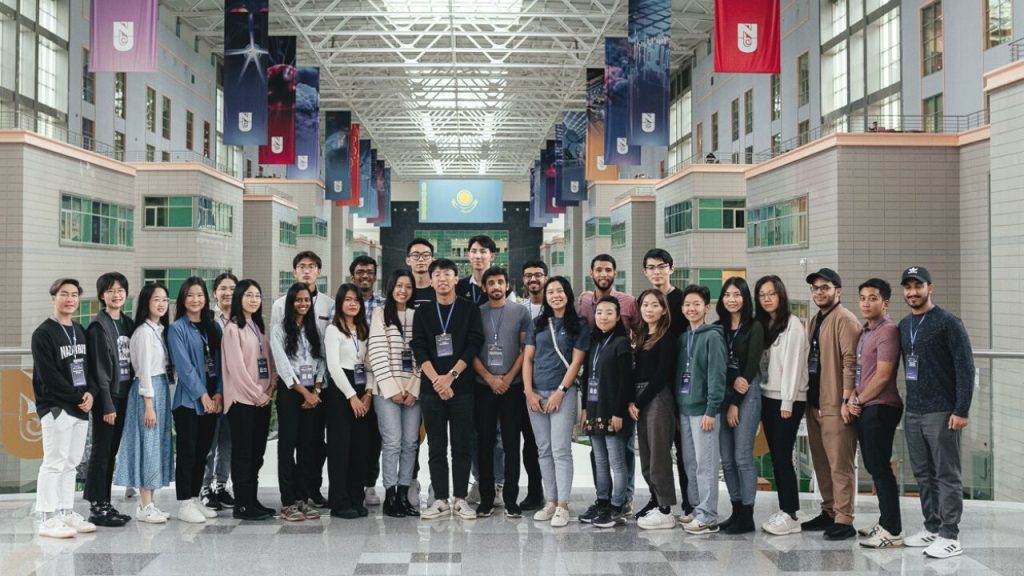
Scientists from the Institute of Smart Systems and Artificial Intelligence (ISSAI), founded by NU School of Engineering and Digital Sciences Professor Hussein Atakan Varol, presented their projects to international students and explained what data they use and from what sources.
The Institute researches human/machine interaction and collaboration, augmented/virtual reality, industrial internet of things, power and energy management, bioinformatics, medical imaging, human augmentation, neural interfaces, AI-integrated wearables for diagnostics, natural language processing, smart city, sensor networks, edge computing, and cybersecurity.
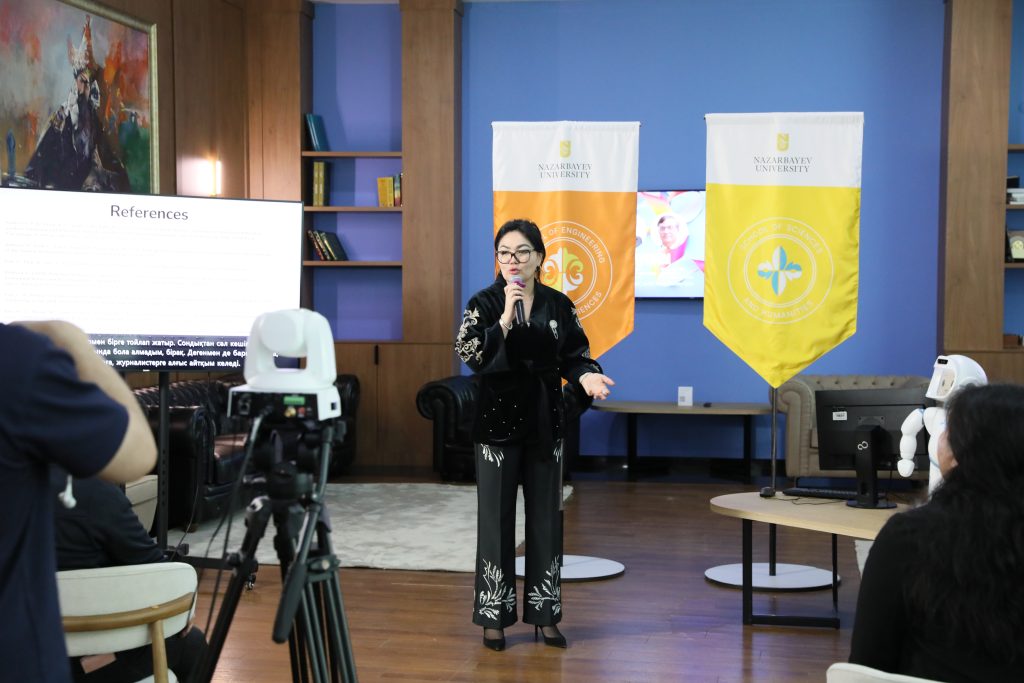
For instance, Askat Kuzdeuov, senior data scientist, spoke about research in the field of computer vision. The technology makes it possible to recognize people’s faces, animal species, and various objects. Just as the human brain consists of neurons and conducts signals, in the same way, a machine uses artificial neurons, but in a more primitive form, to recognize external information. After training, AI is successfully used in health care, industry, logistics, and other fields.
Mateo Rubagotti, Associate professor at the NU School of Engineering and Digital Sciences, introduced students to one solution to the problem of human-robot interaction, for example, in industry, where the robot stops its work as soon as a human enters its space. Whereas robots used to be bulky and unsafe, they are now made of lightweight materials and equipped with better sensors. Scientists are working on safety, primarily for humans and the robot’s efficiency. By changing the robot’s trajectory, the NU researchers adapt its “body movements” according to human movements in space.
At a lecture by Yuliya Semenova, Assistant Professor at the NU School of Medicine, students from Asian universities learned how artificial intelligence helps solve environmental and ecological problems that affect human health. Split into groups, young representatives from Thailand, Malaysia, Emirates, Japan, and other Asian countries together analyzed individual cases. They proposed their solutions to environmental problems using data and artificial intelligence.
Yuliya Semenova, an Assistant professor, noted that data is becoming increasingly important in medicine. During Covid 2019 epidemic, interactive maps using various data created an overall picture of the spread of the virus. Artificial intelligence could replace laboratory animals in the future if it learns how to interpret data effectively and predict the effects of certain substances being tested. Interdisciplinary research is underway at NU, so undergraduate and other programs students of the School of Medicine are learning the basics of programming and gaining knowledge of artificial intelligence.
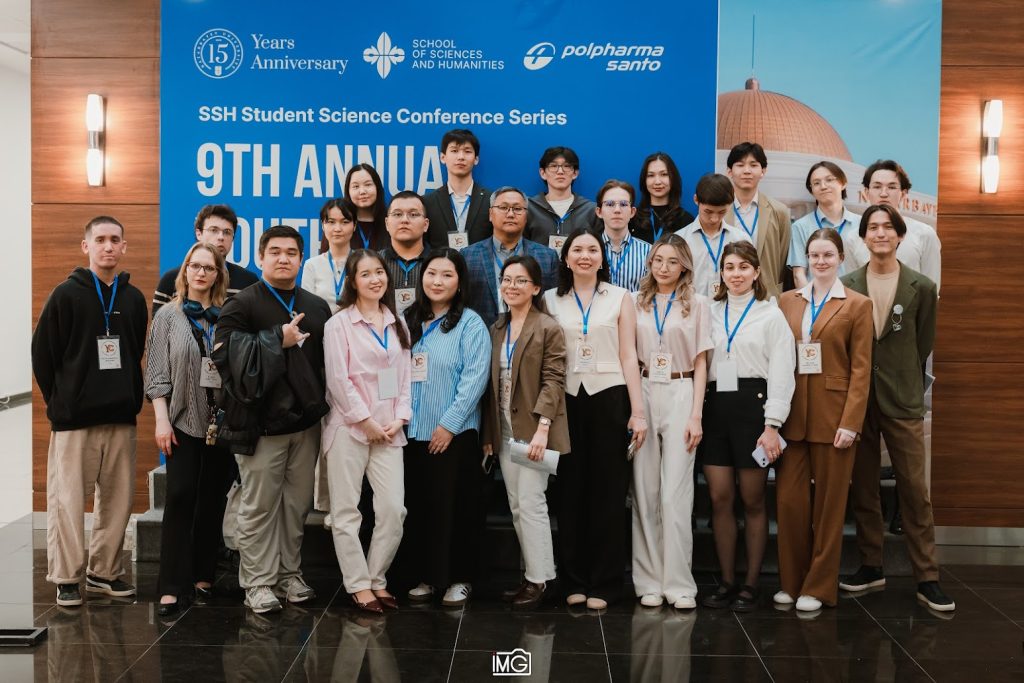
Recall that NU, the only CA representative in the Asian Universities Alliance (AUA), holds the AUA Youth Forum. About 40 students from NU, University of Tokyo, Chula University, IIT Bombay, UAEU, HKUST, Seoul National University, University Malaya, and University of Colombo (online) are participating.
The AUA Youth Forum, which focuses on Artificial Intelligence & Data Science, Asian Civilisations, and Future Habitats, closes on October 28, 2022.