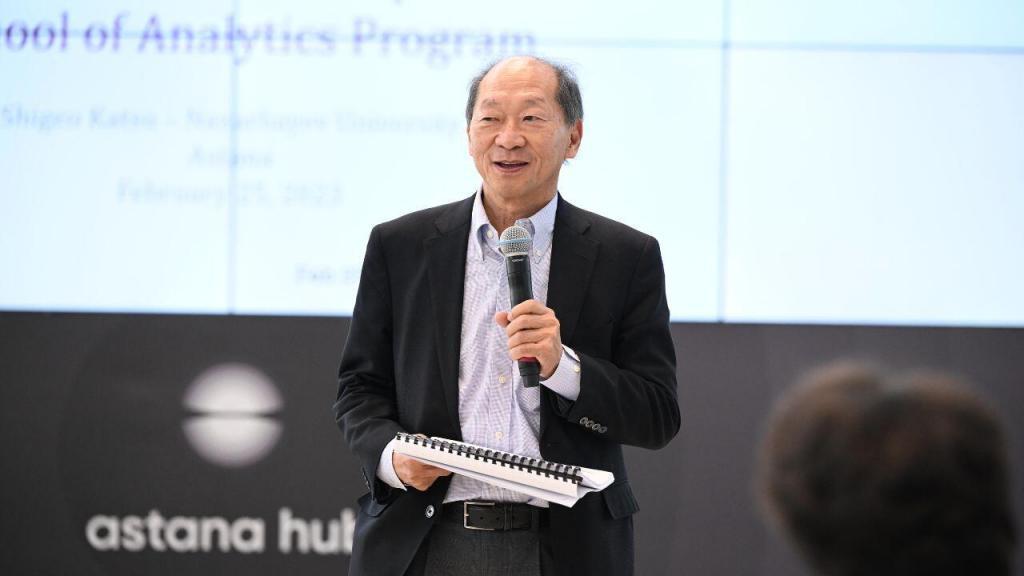
Shigeo Katsu, President of NU, appeared as a distinguished guest at the Kazakh Senate’s School of Analytics, where he gave a lecture titled “Kazakhstan and 2050: Is the Former Strategy Still Relevant?” in Astana on Feb.25
Outstanding economist and policy maker with over 30-year track record of evidence-based policy research and advisory across 50 countries, President Katsu, is the main editor of the Kazakhstan 2050 Strategy and one of the co-authors of the Five Institutional Reforms that Kazakhstan has set forward and committed itself to.
During the lecture, President Katsu gave an overview of the political and economic reforms and the country’s performance on political stability, the rule of law and government effectiveness.
The aim of becoming one of the top 30 most developed countries in the world as part of the Kazakhstan 2050 Strategy “might have seemed unattainable” at the time for many people in Kazakhstan who were confronted with economic difficulties such as low-income levels and inflationary conditions. Nevertheless, “the strategy still acted as a guiding vision for the future, no matter how ambitious it appeared,” President Katsu shared.
After the lecture, the audience was invited to participate in an interactive discussion where they asked questions and offered suggestions. Control of corruption was one of the heated topics that the audience responded to, contemplating the factors and causes of corruption. “Historic legacy should not be overlooked,” President Katsu explained, referring to the Soviet legacy of political corruption in many post-communist societies.
The lecture was part of a program organized by the Club of Young Experts under the Kazakh Senate, which features esteemed experts from Kazakhstan and abroad. In December 2022, Senate Speaker Maulen Ashimbayev endorsed the selection process for the second phase of the School of Analytics. The program aims to strengthen analytical approaches in public administration, social and humanitarian research, and media.
The second phase of the public initiative, known as the “School of Analytics”, received over 300 applications, but a thorough review selected only 60 individuals. During eight weeks, the attendees will meet with lecturers and trainers. The lectures are available in three languages, Kazakh, English, and Russian, and are conducted every Saturday.