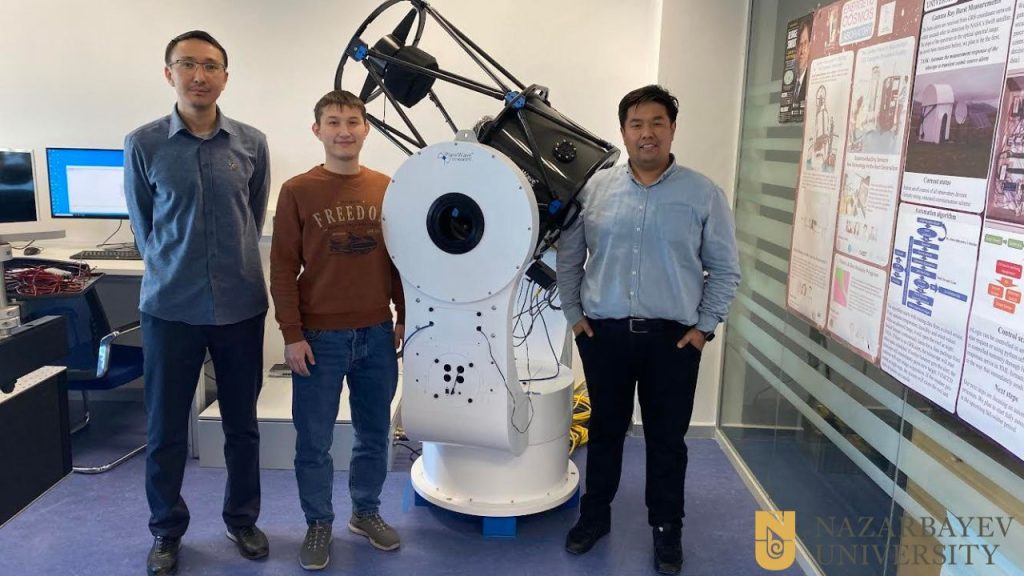
The telescope of NU NUTTelA-TAO, located at the Assy-Turgen Astrophysical Observatory, on the evening of March 28, 2023, made a unique and innovative observation of a cosmic event called a Gamma-ray burst (GRB). GRBs are the brightest electromagnetic events occurring in the Universe. Despite decades of efforts by the international scientific community, their exact nature and parameters remain elusive. A scientifically valuable observation was made by the team of astrophysicists at the Energy Space Laboratory: research engineer Zhanat Maksut, postdoctoral researcher Toktarkhan Komesh, researcher at the University of Berkeley Bruce Grossan, and engineer Nurzhan Shaimoldin.
“We observed the gamma-ray burst GRB230328B at 20:55:23 (UT 14:55:23) on March 28, just 41 seconds after the start of the phenomenon. This is the fastest optical multi-channel observation of a gamma-ray burst ever recorded. We observe the event simultaneously in the green, red and infrared ranges, which gives us a better idea of the spectrum of the signal. These observations were made possible because of the unique characteristics of our telescope: its high speed and simultaneous observation by three ultra-sensitive cameras. The observation has already been announced to the international scientific community,” said Zhanat Maksut, Research Engineer of the Project Group of the NU Energy Space Laboratory (ECL).
The next telescope, in one of the 14 observatories that also conducted observation, was able to start monitoring the gamma-ray burst only at the 30th minute after the trigger.
The observed data is currently being analyzed in-depth by a team of researchers at the NU Energetic Cosmos Laboratory. The analysis is expected to shed unique light into the nature of GRBs.
The Energetic Cosmos Laboratory was founded at NU in 2016 by Nobel Prize winning astrophysicist cosmologist George Smoot III and Kazakh scientist Kanat Baigarin
“This is a big step forward in our observational science. It is important to recognize that this is what we started to do and it depended not only on having the vision, the funding and work to fabricate and install the automated telescope and instrument system but also that the team had to be professional, dedicated, and skilled to have the system up and operational but also to actually gather the observations. Now is the fun portion of being lucky to have a good source and results and to process and analyze finally publishing a significant step forward. I commend the team for achieving this.” Dr. Smoot commented.
“We are number ONE in the world. We started observation at UT 2023-03-28 14:55:23 , 41 sec after the trigger, the next 14 other observatories around the world were observing the target. The earlier observation was made 30 minutes after the trigger.” – Professor Kanat Baigarin said.
Previously, the ECL team, using the NUTTellA-TAO telescope, was able to make observations of the earliest stage of the GRB201015A Gamma-Ray Burst, starting at 58 seconds after the Swift-BAT trigger. Using simultaneous observations from three EMCCD cameras, they were able to prove evidence of “dust destruction” – a theory proposed earlier by American scientists. The results of the observation were published in the prestigious Monthly Notices of the Royal Astronomical Society journal.
“GRB20115A – is unique in that it occurred at a distance of 5 billion light years. It is assumed that the destruction of the dust is the cause of the color change at the earliest stage of the gamma-ray burst. Observing such phenomena at an early stage requires a telescope that moves very quickly and captures several wavelengths at the same time. There are only a few such telescopes in the world, and all of them can observe only after 1 hour at maximum speed. Our NUTTellA-TAO telescope can turn around and observe any celestial object in 8 seconds,” said Tokhtarkhan Komesh, a researcher at NU ECL.
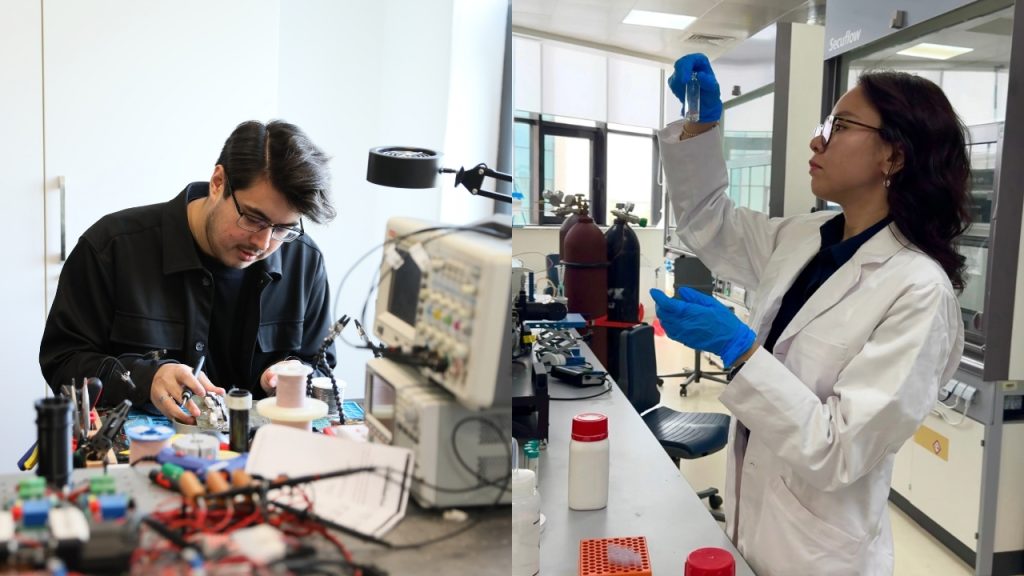
Energetic Cosmos Laboratory is an astrophysics laboratory founded by Nobel Prize winner George Smoot in 2016 at NU. The main goal is to understand fundamental problems in physics and astrophysics and contribute to the technical know-how and innovation ecosystem of NU. ECL includes a number of research facilities. We created and operate the NU Transient Telescope for optical observations of fast transient phenomena. We have a cryogenic detector facility including an electronics testing and assembly lab, and a clean room facility, where we work on quantum sensors. We also have a shop where we can do CNC machining and 3D resin printing for the fabrication of our experimental equipment. ECL conducts original research in several areas, including theory, data science, telescope observations, cryogenic detectors, and ultra-fast astronomy. We focus on topics relevant to cosmology, gravity, and high-energy astrophysical processes.
To learn more about NU telescope and laboratory, please visit our website.