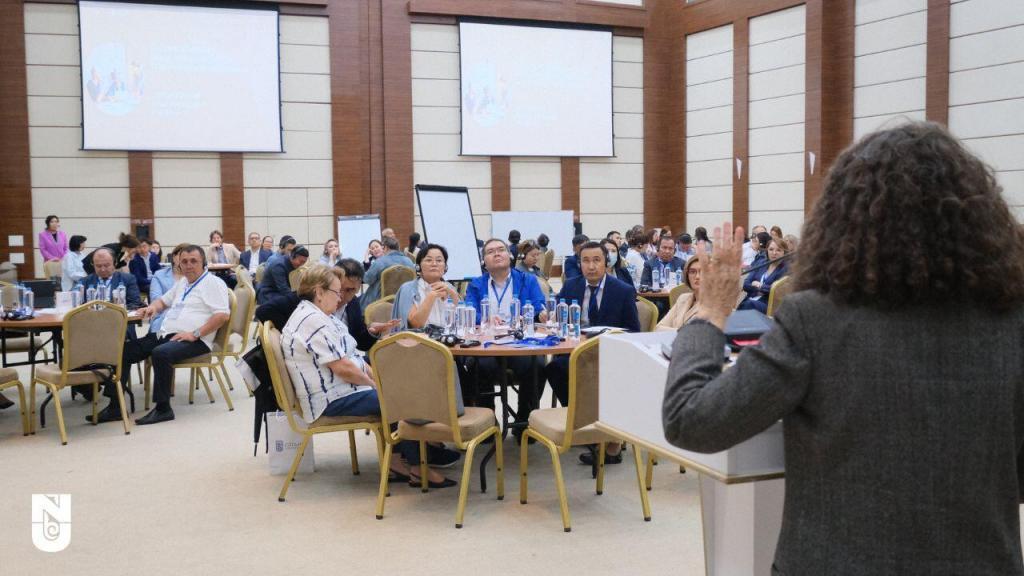
The project was developed by the NU Graduate School of Education at the initiative of the Kazakh Ministry of Science and Higher Education. The program, launched in April 2023, aims to build leadership skills and improve university administrations’ competencies in today’s dynamic environment.
Opening the session, Acting NU President Dr. Ilesanmi Adesida noted the exceptional role of university leaders in promoting reforms for the development of society and the country, because it is the university that lays the foundation and provides a platform for realizing the potential of future specialists in various fields.
Bolat Tokezhanov, Chief of Staff of the Ministry of Science and Higher Education, speaking to the program participants, noted the importance of each topic that the Academic Leadership Institute course covers. Among them are sustainability, governance, organizational change and talent management. “Increasing competence in these areas is designed to create leaders capable of initiating significant transformations in their educational organizations,” Tokezhanov emphasized.
The Academic Leadership Institute program consists of nine modules, each of which covers specific transformation processes at a university, such as university values and their significance for society, leadership, restructuring the university, addressing student issues and ensuring the quality of academic programs. As part of the course, participants listen to lectures by representatives of ministries, deputies of the Kazakh Parliament, and national and international experts in the field of higher education, as well as work in groups, solve practical problems and share experiences.
“Such programs are useful because it is important for education managers to communicate with each other. Often when promoting an innovation, the team can have a hard time accepting the change. And such platforms allow you to share experiences and find out that another university has already implemented this, there is a precedent. Rectors and vice-rectors have excellent academic backgrounds, but they do not always have management skills. And it’s not our fault, it’s everywhere. And such programs, among other things, help to pump these skills,” said Duman Aitmagambetov, the program’s participant and the Vice-Rector for Strategic Development of the Eurasian National University.
The sixth module “Organizational Change” was moderated by NU Graduate School of Business’s Dean Joseph Konings and Deputy Dean Venkant Subramanian. During the module students learned the key aspects of change management, including leadership strategies, marketing, branding, PR and digital marketing. The second day was devoted to the financial aspects of organizational change, such as planning, budgeting, forecasting, asset and risk management.
Another participant of the program, Vice-Rector for Academic Affairs of Karagandy Technical University Aizhan Temirbaeva emphasized that in six modules, students learned to analyze and look for solutions.
“The modules formed by NU help us, as leaders, learn to reflect: what works and what doesn’t, what needs to be done to make it work? These courses provided quality networking. The heads of all universities are scattered across the regions, but when you join focus groups and discuss, you understand that the problems are common and systemic everywhere. Our task is to enable us to unite minds and realize the tasks set to improve the quality of education, internationalization, etc.,” she said.
On August 19, within the framework of partnership with the Eurasian National University, the seventh module of the program, “Talent Management” will be held within the walls of this university. The module program will provide participants with the opportunity to learn best practices in the implementation of a talent management system in foreign universities, as well as improve the effectiveness of talent management in an international educational environment. Particular attention will be paid to the topic of talent management as a key personnel practice in modern Kazakhstan.
The next, eighth, module will include trips to top universities in the UK – University of Bath, Cardiff University, University of Reading. There, the participants will learn about the best British experience in transforming universities, sharing knowledge on improving the skills of leaders and improving management in the academic environment. Based on the results of the entire program, participants will defend their projects, receive certificates, and, most importantly, knowledge and experience to improve the work of universities.