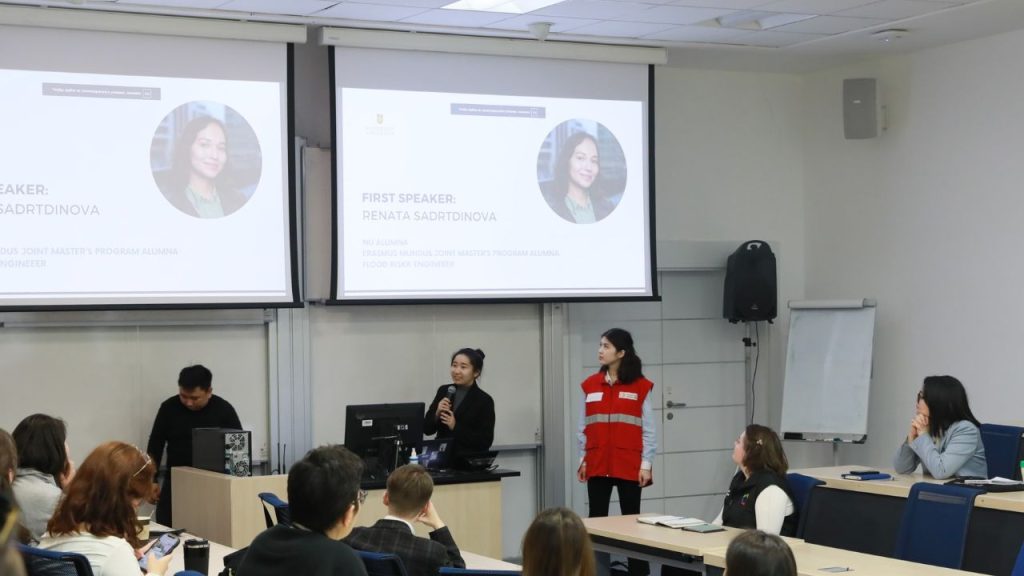
The event was organized by SDSN Youth, the global youth initiative of the UN Sustainable Development Solutions Network, in cooperation with NU and the NU Red Crescent Society. Experts on various natural disasters, including floods, earthquakes, forest fires and epidemics, gathered in an online and offline discussion to share their perspectives and assess the current situation.
The key speaker of the discussion was Renata Sadrtdinova, an NU graduate in Civil Engineering and flood risk engineering expert. The speaker noted that large-scale floods in 2024 are caused by at least two factors: a very snowy winter and an abnormally “warm” March in the history of the country and the planet. In Kazakhstan, the average monthly temperature in March was higher by 1.2 degrees. The specialist noted that this trend would continue, so rebuilding the entire flood protection system, repairing infrastructure and setting up monitoring are inevitable to reduce risks from high water.
“Kazakhstan needs to study Flow Control Systems, i.e. mechanisms prepared in advance to protect and slow down the flow due to the high speed of current flows. It is also important to develop an integrated flood management system in the regions based on the example of foreign experience. It is necessary to develop local protection schemes applicable to territorial peculiarities in the most flood-prone regions, such as the North-, East-, West-Kazakhstan, Akmola and Atyrau regions. It is also important to train the population and build monitoring and warning systems for citizens”, – said Renata, answering the questions from the audience.
Another speaker, Dr Antonio Sarria-Santamera, a professor at NU who studies effective health systems, noted the importance of developing scenarios for possible emergencies and measures to prevent future emergencies and their aftermath. He shared views on potential risks from floods on public health, including mental health, and discussed the importance of ensuring those affected access to clean drinking water.
“The most important and immediate thing to reduce the risk of deterioration is – access to clean water for people now in evacuation zones. In such situations, clean water is more important than even food to avoid a spike in gastroenterological diseases. Ways of solution – providing access to bottled purified water, local water purification, boiling,” he emphasized, adding that another extreme opposite emergency – drought – is predicted to increase in Kazakhstan. “This is something that the authorities, the scientific and expert community, and the people in general need to learn how to cope with and minimize risks. To adjust the system to these needs.”
Tatyana Mironyuk, executive director of the National Volunteer Network of Kazakhstan, also attended the meeting. She discussed the network’s work, the measures being taken now, and the difficulties that have to be faced.
“What are we doing now? First of all, it is training volunteers and working out algorithms. Even humanitarian cargo should be collected correctly; many people need to think about how to sort, label, and send it because now many cargoes are sent to the regions. Imagine a huge truck full of stuff comes in, and things fall out of it completely unsorted, so we need to be trained in advance on collecting humanitarian aid, and we have algorithms. You must prepare and read that algorithm even if you don’t have time.”
The students learned more about the things needed by the evacuated citizens today—such as mattresses, boats, rubber boots, medicines, hygiene products, heaters, etc. They also discussed the charitable actions organized by NU’s management, staff, and student organizations to help those affected.