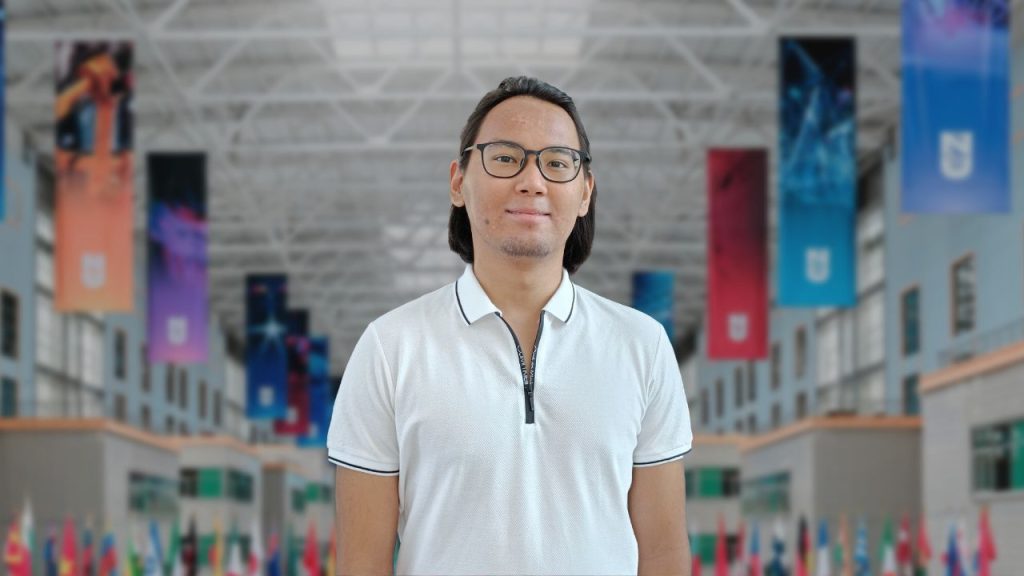
This year, Arman Bolatov, a third-year undergraduate student majoring in Computer Science, participated in IMC from NU. It is the second gold to the University’s piggy bank after Batyrkhan Orynkul, who took first place in 2016. But, for Arman, it is the first gold medal, which became a great gift for his birthday on August 14.
“During the two-day competition, Arman received 43/80 points, which means he completely solved 4 out of 8 difficult problems, which is a very good result. Arman is a passionate mathematician,” said Assistant Professor at NU SSH Piotr Skrzypacz, who prepared the SIAM club students for the IMC. After all, every year since 2012 a group of students from NU went to this Competition, but this time the consequences of the pandemic have made adjustments to the organization of the event.
The 29th International Mathematical Competition (IMC) for university students was held in Bulgaria, August 1-5, 2022. This year students competed in a hybrid mode: offline in Blagoevgrad (Bulgaria) and online, to which only Arman managed to register from the university team. The Olympiad was the largest in terms of the number of participants: 664 students and 100 teams went through two stages, each lasting four hours.
“If in previous years it was enough to solve one problem out of 8 to get bronze, this year two problems – bronze. Three problems are silver, and four are gold. I was lucky with the problems because I studied linear algebra in depth during the semester, and two of the proposed problems were just on this topic. I solved them and the first two problems of the rounds. It turned out to be gold,” modestly said Arman.
Mathematics has always attracted him. The Taldykorgan NIS student won bronze and silver at the various olympiads. Now, he is fascinated by beautiful abstract mathematical concepts, but even more by the moment of learning the meaning of a single concept.
“Mathematics can be roughly divided into two parts, applied and pure. The applied part is the one that is of practical use to humanity. For example, the Institute for Intelligent Systems and Artificial Intelligence (ISSAI) uses mathematics to solve everyday problems. The rest is pure mathematics. But sometimes, sections and concepts in mathematics that were once considered part of pure mathematics find applications in real life. For example, number theory, which explores prime and integer numbers, was long considered inapplicable. But, over time, theorems from number theory became the basis for encryption of messages and signals, something we now use every day when sending messages on social networks,” said Arman.
He is a member of the Society for Industrial and Applied Mathematics (SIAM) club at NU and works as a research assistant at ISSAI, where scientists apply machine learning techniques. Arman is now helping to assemble a dataset of Central Asian food images and train image classification models, which may be helpful in the food industry. He is glad to be NU’s student and to do research.
“If we compare Kazakhstan, NU is the best option for those who want to do science. NU has strong professors in almost every field looking for students for their research. Also, NU has well-equipped labs for biologists, chemists, physicists, geologists, robotics, and even programmers! For example, ISSAI has supercomputers, some of the coolest in the world for deep neural network training,” noted Arman Bolatov.
When studying new topics, according to Arman, it is crucial not just to memorize the algorithm mechanically but also to understand the essence and concept of the material. The most curious seek additional sources of information.
“Personally, I can recommend the “Ask” forum (ask.bc-pf.org) of the Beyond Curriculum Public Foundation, where students and schoolchildren solve problems and help each other. I often sit there myself, asking and answering questions. In addition to questions on problems, “Ask” gives useful tips for effective learning, discusses the philosophy of preparing for the Olympiads, and more. Come on in, check it out!” added he.
Arman Bolatov wants to continue his studies in master’s or doctoral programs after graduation, to study applied mathematics and do research in machine learning.
We wish Arman success and new heights in mathematics!