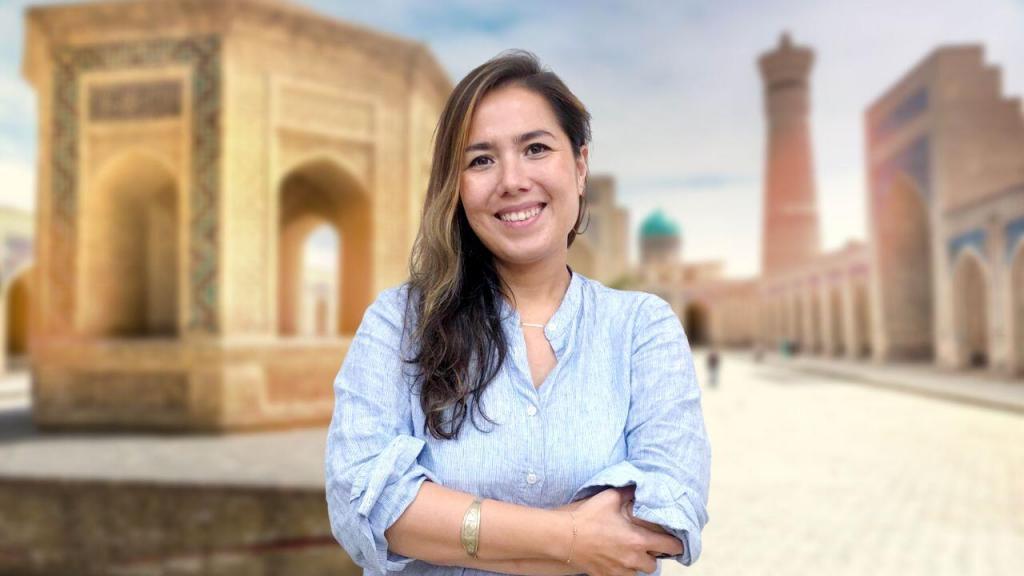
Now, as a doctoral student at the Graduate School of Education at NU, she studies youth national identity formation among youth in Uzbekistan. Obtained insights can be exposed to other regional contexts.
Please tell us a little about your education and professional experience.
I hold a Bachelor’s in English Studies and my first Master’s degree in Didactics of French from the University Bordeaux Montaigne in France. After graduation, I started working as a French and English language instructor for the Japan International Cooperation Agency (JICA) to train and prepare JICA volunteers and development workers for their assignments in low-middle-income countries. Then after a few years, I returned to university and obtained an MA in Education and International Development from the Institute of Education, University College of London.
After graduation, I worked as an education consultant for a Japanese consulting company in international development for four years. In this role, I managed and coordinated several technical assistance projects in education. I was mainly involved in projects funded by JICA and the Japanese Ministry of Internal Affairs and Communications in Bangladesh and Uzbekistan. Over the last two years, I have worked as a research assistant for the Global Challenges Research Fund (GCRF)-funded Project, Political Economy of Education Research (PEER) Network in the Central Asian hub.
What is your doctoral research about?
My research explores the educational experiences of Uzbekistani youth and the formation of their national identities. More precisely, it aims to understand how formal school education shapes the national identities of young people in Uzbekistan through the intersectionality of several markers, namely, ethnicity, gender and religion. Given the complexity of national identity and the diversity of youth in Uzbekistan, the research adopts an ethnographically informed qualitative approach. I am currently preparing for my fieldwork in Uzbekistan, during which I will observe, interview and conduct focus group discussions with Uzbekistani youth from different backgrounds to explore how education influenced the construction of their national identities.
What is the applied meaning of your work?
Central Asia is an exciting context due to its dominant youth population. Remarkably, 60% of Uzbekistan’s population is under 30. Youth represent the country’s future, and their inclusion in all realms of society is crucial to building a cohesive, just and peaceful society. Whilst education is a powerful tool to mold citizens and shape their national identities, research has yet to empirically explore the relationship between schooling and youth national identities in Uzbekistan. Most importantly, the knowledge of Uzbekistani youth perspectives about their nation is crucial in shaping Uzbekistan’s policies for nation-building. Hence, the study will reveal how national identities are constructed and inform the policies needed to promote national unity and a cohesive and inclusive society. While my research focuses on Uzbekistan, given the Central Asian countries’ geographical proximity and, above all, shared historical commonalities, my research can potentially offer valuable insights into other regional contexts.
What could you tell us about the process of working on your dissertation?
I have recently defended my research proposal and am starting my fieldwork in Uzbekistan very soon, during which I will collect my primary data. I have a fantastic supervisory team, including Professor Naureen Durrani and Professor Zumrad Kataeva from NU GSE, and Professor Amalia Daché from the University of Pennsylvania, who have been supporting me throughout my doctoral journey. While the doctoral journey can sometimes be quite isolating, I have built a supportive relationship with my peers with whom I continuously exchange ideas, support and challenge each other. I have also been a research assistant in a Global Challenges Research Fund (GCRF)-funded Project, the Political Economy of Education Research (PEER) Network, mainly focusing on the network’s work in Central Asia. I have had incredible opportunities to work with inspiring colleagues from Central Asia, South Africa, and the UK, from whom I have benefitted immensely. The Project supports early career researchers, so being part of the research team has allowed me to deepen my theoretical knowledge in the field of political economy and shape my doctoral research.
Please tell us about your plans.
Of course, my current priority is to conduct fruitful fieldwork, complete my dissertation and successfully defend my PhD. After graduation, I want to work as an academic and specialise in the field of education and development in Central Asia, particularly focusing on the processes of identity formation.
What would you wish for future doctoral students?
For those who are starting their doctoral journey, I advise them to read a lot and work closely with their supervisors and peers. The doctoral journey for sure gives you no respite and can sometimes be overwhelming, but it is quite an exciting journey which transforms your thinking in a way you might not have imagined. Throughout intellectual exchanges with supervisors, peers and academics, and self-reflections, you continuously grow and mature your philosophical, intellectual and analytical stances, constantly evolving your perspectives about education and society. After a few months, you will realise how this process completely transforms you as a scholar, and the world does not look the same way anymore, which is an incredible feeling. Furthermore, the relationship you build through your research engagement is priceless. I wish everyone on this journey all the very best.