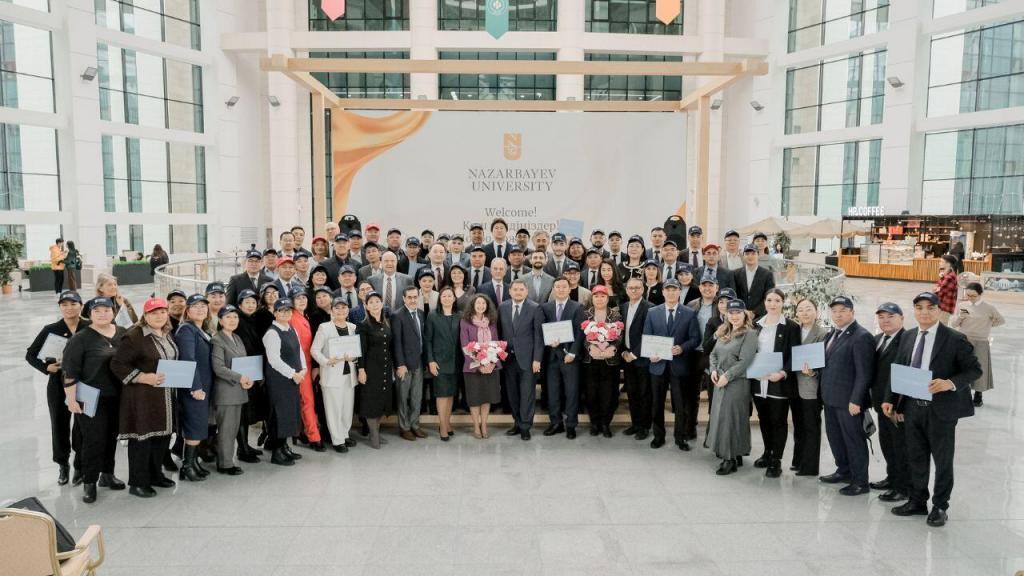
NU hosted on Dec. 1-2 the final module of the Executive University Leadership Program – a professional development program for heads of public universities in Kazakhstan, prepared by NU Graduate School of Education (NU GSE) on the initiative of the Ministry of Higher Education and Science.
In her welcoming speech, Deputy Prime Minister Tamara Duissenova noted the importance of implementing the task of improving the quality of education set by the Head of State.
“A lot of work is being done in the social and infrastructure sectors. At the same time, the task of improving the quality of education remains paramount. We have prepared a draft national report. Its goal is to shift from the paradigm of organizing the learning process to the paradigm of shaping a personality. A holistic approach will help create continuity of learning. It is important that the rectors and vice-rectors, who have improved their competencies in this program, now pass on the knowledge to middle management,” the Deputy Prime Minister said.
Completing the Executive University Leadership Program, organized by NU GSE, provided the heads of 28 public universities in Kazakhstan (including rectors, vice-rectors, deans and directors of departments) with the knowledge, innovative technologies, and practical tools necessary for effective management of universities in a dynamic and increasingly complex environment. Vice Minister of Science and Higher Education Talgat Yeshenkulov thanked NU for the program organization and noted the importance of the course’s practical component.
“Training leaders of higher education is one of the issues the ministry controls. Colleagues from NU supported our proposal and prepared a high-quality course consisting of 9 modules. The program includes such practical areas as leadership development, decision-making, research activities, comparison and application of foreign experience,” the vice minister noted.
The program, launched in April 2023, consisted of 9 interactive modules. Each module was devoted to different processes of transformation at a university, including university values, leadership, review of university structure, resolving student issues, and ensuring the quality of academic programs. As part of the course, national and international experts in the field of higher education, representatives of ministries, and members of the Kazakh Parliament gave lectures to participants. Rectors and vice-rectors also worked in groups, solved practical problems, and shared experiences and cases about the work done in other universities.
As part of the 8th international module, participants were able to study in detail the best practices of highly ranked British universities – Bath University, Reading University, and Cardiff Metropolitan University.
During the final module, over 2 days, participants defended their group projects, answering questions about what technical, pedagogical, and national universities of the future should be. They also discussed the draft National Report “Quality Education Available to Everyone”.
According to Dean of NU GSB Aida Sagintaeva, one of the goals facing the school is to promote the systemic transformation of universities and help transition to a new model of their management through the development of leadership and professional skills of top managers in education. Commenting on the draft National Report, the Dean emphasized the importance of digital transformation in higher education. “I think hybridity and flexibility will be key features of higher education in the future. I’m not just talking about online education, I’m talking about the HyFlex education model, which should combine synchronous and asynchronous learning. A hybrid approach to higher education should help ensure inclusion and accessibility of higher education,” noted Sagintaeva.
At the end of the course, on Dec 2, Minister of Science and Higher Education Sayasat Nurbek awarded 81 university heads with a certificate of completion. The Minister thanked everyone for their active participation and expressed hope that the conclusions and ideas obtained from the course will be applied in practice. To note, this course was held as part of the “Academic Leadership Program” project. There are also plans to create similar courses for deans and other key categories of university employees. Partners of the Executive University Leadership Program are Al-Farabi Kazakh National University, Gumilev Eurasian National University, Bath University, Reading University and Cardiff Metropolitan University, as well as international experts in higher education David Locke and Dr. John Davis.