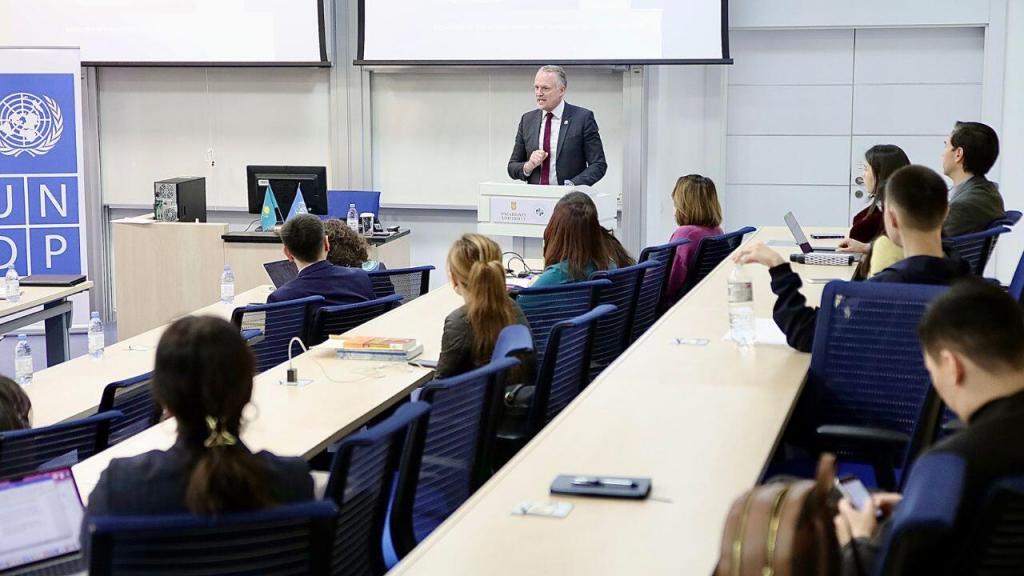
NU always provides a platform for the expert community to generate ideas and exchange knowledge. On January 24, the guest speaker was Deputy Regional Director of the UN Development Program, Nick Rene Hartman, who visited Astana during a working visit. Teachers, students, undergraduates, and doctoral students of NU gathered to listen to an important lecture on the topic “Unleashing the Potential of Women and Girls in STEM,” dedicated to the International Day of Women in Science.
Welcoming the guest speaker, Vice President for International Cooperation, Darkhan Bilyalov, highlighted the fruitful collaboration between NU and UNDP in promoting sustainable development goals.
“Our collaboration has paved the way for events such as major youth conferences and guest lectures on crucial topics. NU is committed to promoting an inclusive approach and gender equality in education, along with supporting environmental initiatives. Nearly 34% of our publications indexed in Scopus from 2011 to 2023 focus on the SDGs,” noted Darkhan Bilyalov.
During the lecture, Nick Hartman noted that according to the latest data, only 30% of STEM graduates are women, underscoring a significant underrepresentation in comparison to their male counterparts. This mirrors a global trend where women continue to face disproportionate challenges in STEM fields, at large due to gender bias and stereotypes.
It is noteworthy that NU is actively addressing this disproportion: over 40% of students studying STEM disciplines are female. The university takes pride in the continuous growth of this figure every year.
“Here I would like to compliment NU researchers under the leadership of Professor Naureen Durrani. Their study illuminates how school textbooks entrench gender power relations, construct dominant masculinities, and enact emphasized femininities. All textbooks chosen for the study – overrepresent males in leadership activities related to the domains of politics, military, literature, fine and performing arts, and government in both text and images. Gender analysis provided by research team’s like prof. Durrani’s are a bright example where UNDP’s work can be complemented by academia, and in some cases even work together. The Gender Alliance launched last year with NU and UNDP is a living proof of that,” noted Nick Hartman.
The lecture concluded with a question and answer session where participants discussed gender imbalance in science, along with potential solutions. In his closing remarks, Hartmann emphasized the role of UNDP in promoting gender equality and introduced the #STEM4ALL initiative, aimed at strengthening the role of women and girls in the scientific field.