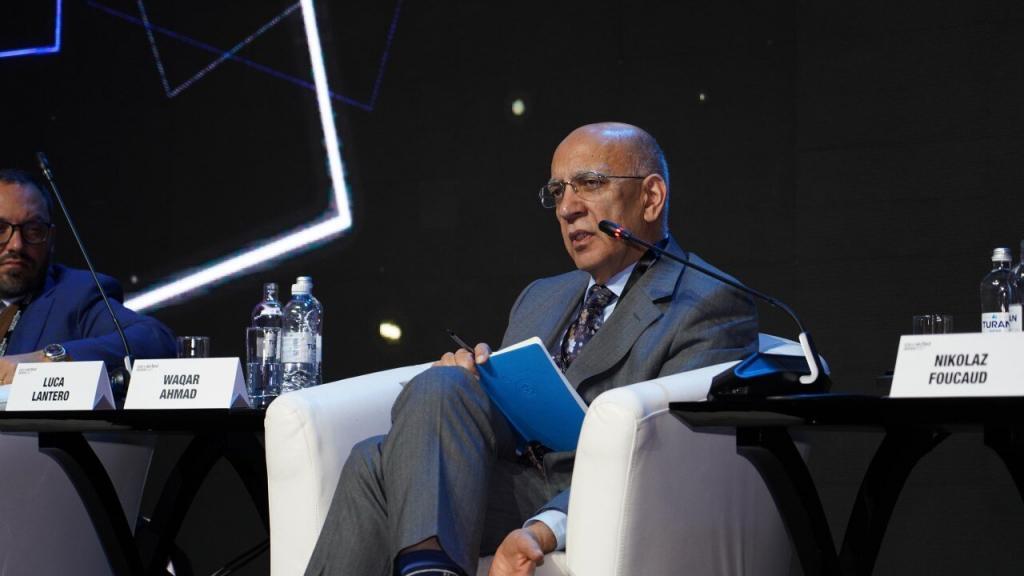
Among the speakers were NU representatives – President Waqar Ahmad, NLA CEO Dos Sarbassov, and Vice Provost Aida Sagintayeva.
At the panel session “Global competitiveness of higher education: building a strategy”, Waqar Ahmad spoke about the strategy of Nazarbayev University, which seeks to become a model for reforms in the higher education and science system of Kazakhstan.
The President emphasized international partnership, the creation of strategic alliances with global institutions for knowledge sharing, joint research and academic mobility. For example, in 2023, NU signed 20 memoranda of partnership with educational institutions from nine countries, thereby significantly expanding the geography of global cooperation, received about 100 delegations from diplomatic missions, educational institutions around the world, educational agencies and companies, fostering dialogue and cooperation in various fields of study.
Professor Waqar noted that NU creates an academic environment that attracts and retains world-class faculty and researchers, offering competitive conditions and opportunities for professional growth. To date, the total number of the university’s teaching staff is more than 500 people, of whom more than 200 are Kazakhstanis, including 61 graduates of the Bolashak International Scholarship, which demonstrates NU’s commitment to building local capacity.
Dina Saifutdinova, Director of the Department of Social Projects and Programs of the NU Social Development Fund, took part in the panel session “Impact Investments: Attracting Capital for Social Change”. She spoke about the significant contribution of NU students and graduates to social change. Dina noted how the University’s supportive ecosystem promotes innovation, creativity, and collaboration within social projects. Such an environment allows for the creation of sustainable and meaningful solutions, making NU a leader in supporting socially responsible initiatives.
Forum participants also discussed the challenges posed by the rise of technology and artificial intelligence. They underscored the importance of integrating digital innovations into educational processes and conducting relevant research, as well as the need to develop programs to prepare in-demand specialists for the global labour market, where special attention is paid to soft skills, critical thinking and interdisciplinary knowledge.