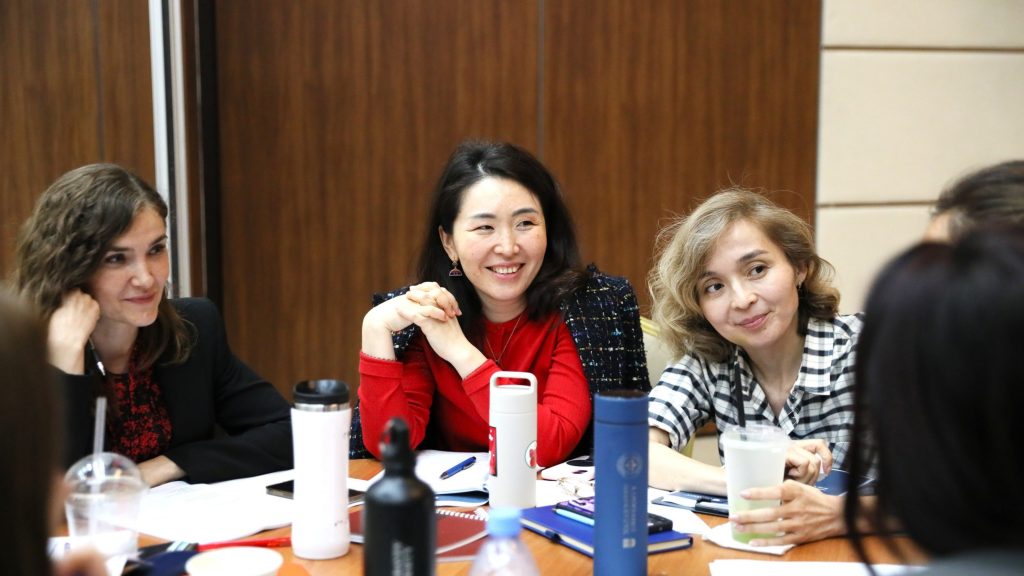
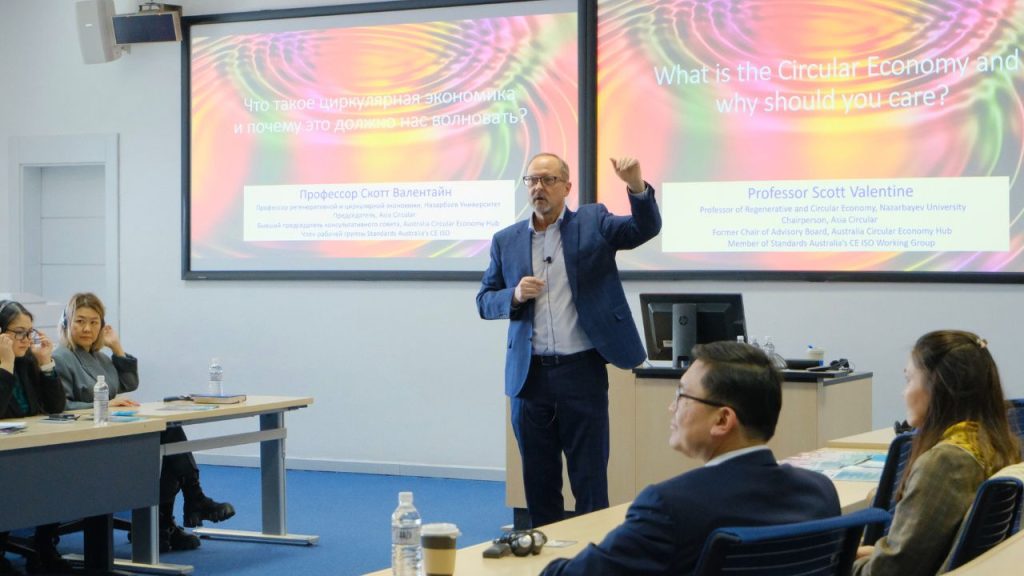
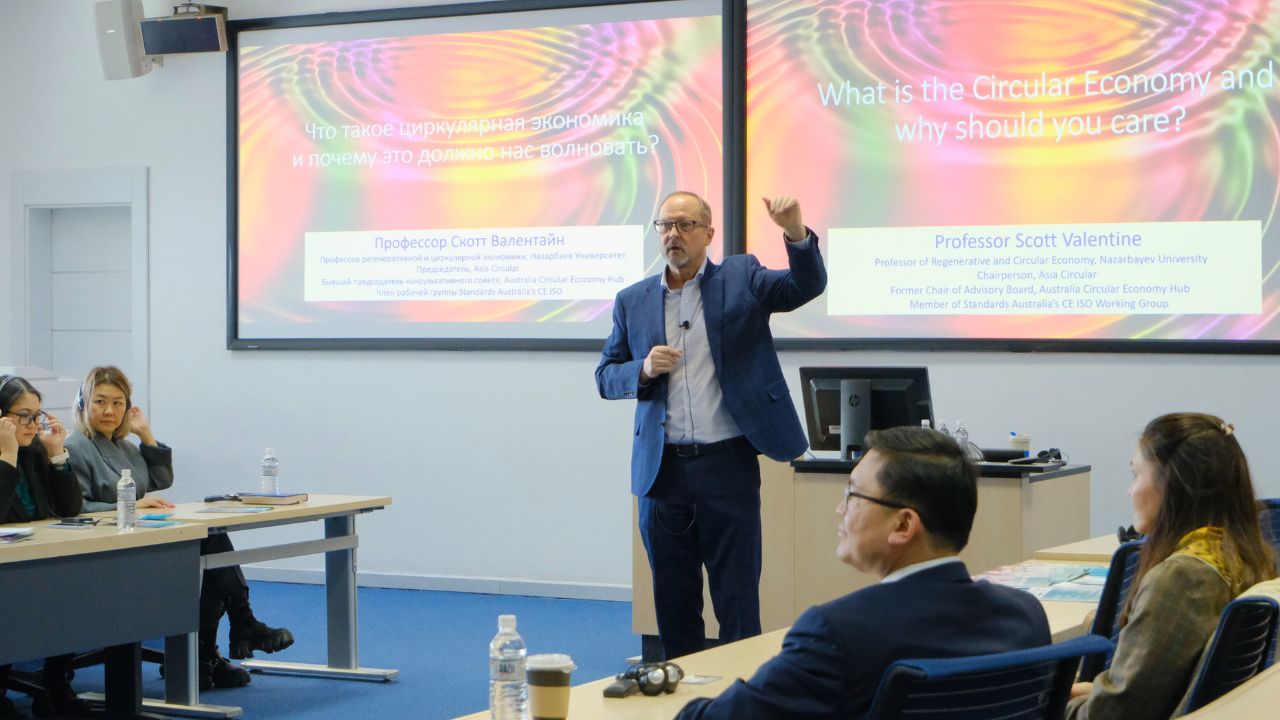

Nazarbayev University’s Graduate School of Public Policy (GSPP) hosted an open lecture by Professor Scott Valentine titled “Circular Economy: Creating a High-Performance Public Sector,” bringing together representatives of public-sector organizations to discuss how circular economy principles can boost productivity, strengthen communities, and support Kazakhstan’s long-term development goals.
Speaking to policymakers and practitioners, Dr. Valentine emphasized that the circular economy is often misunderstood as recycling alone. In fact, he said, it is a broader economic framework focused on maximizing the value of resources through smarter design, reuse, and productivity gains across entire systems. Global companies such as Apple, Professor noted, generate significant profits by refurbishing and reusing products rather than relying on recycling alone.
“Recycling is the least efficient option,” Dr. Valentine said. “The real value comes from designing systems that reduce resource use from the start, and from reusing and repairing materials before they ever reach the recycling stage.”
Dr. Valentine explained that circularity allows byproducts, including agricultural and industrial waste, to be transformed into high-value secondary products, creating new revenue streams for businesses. Drawing on examples from Japan, where he lived for several years, he described a sake production plant project as the center of an integrated circular ecosystem. Around the plant, waste streams would support mushroom and algae cultivation, water purification, pig and fish farming, local market sales, and educational programs for secondary school students on marketing and eco-farming.
“Circular economy innovations always reflect local context,” Valentine said. “That’s why a circular economy in Kazakhstan will look very different from one in Japan. In cities like Astana, which are still shaping their identity, circular initiatives can help build community and drive long-term innovation.”
Circular strategies align closely with the United Nations Sustainable Development Goals and are increasingly embedded in global trade rules. Beyond the private sector, Dr. Valentine highlighted opportunities for government agencies. Public institutions can reduce costs and improve service delivery by optimizing procurement, redesigning operations, and applying circular thinking to everyday processes.
“Circular economy is about thinking outside the box,” he said. “It’s about seeing value where we once saw waste — and designing systems that work better for the economy, society, and the environment.”
The lecture also addressed the growing role of artificial intelligence in circular systems. AI tools can analyze resource flows, identify inefficiencies, and support the design of more resilient and productive systems. When combined with circular practices, digital technologies can significantly enhance national competitiveness.