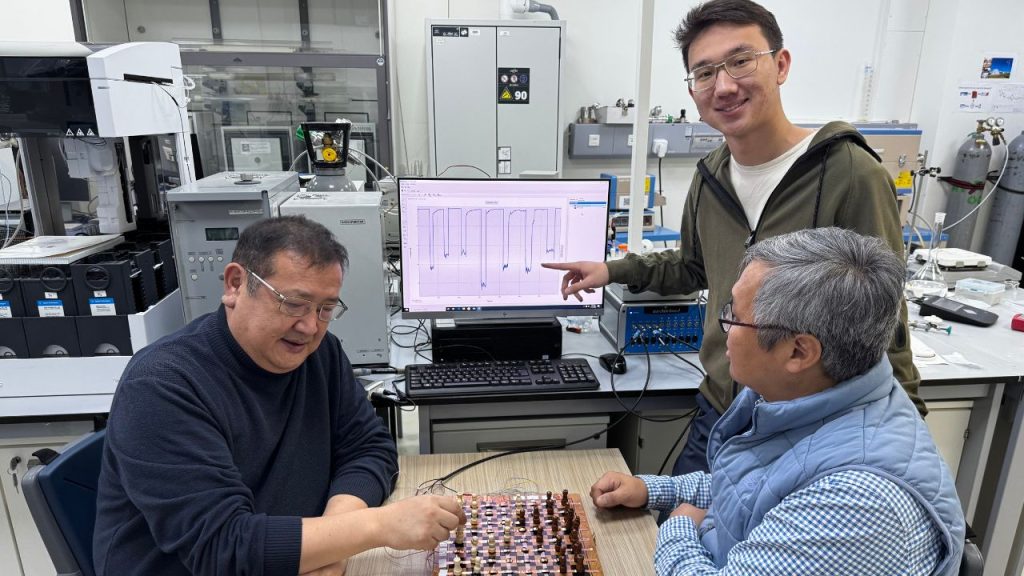
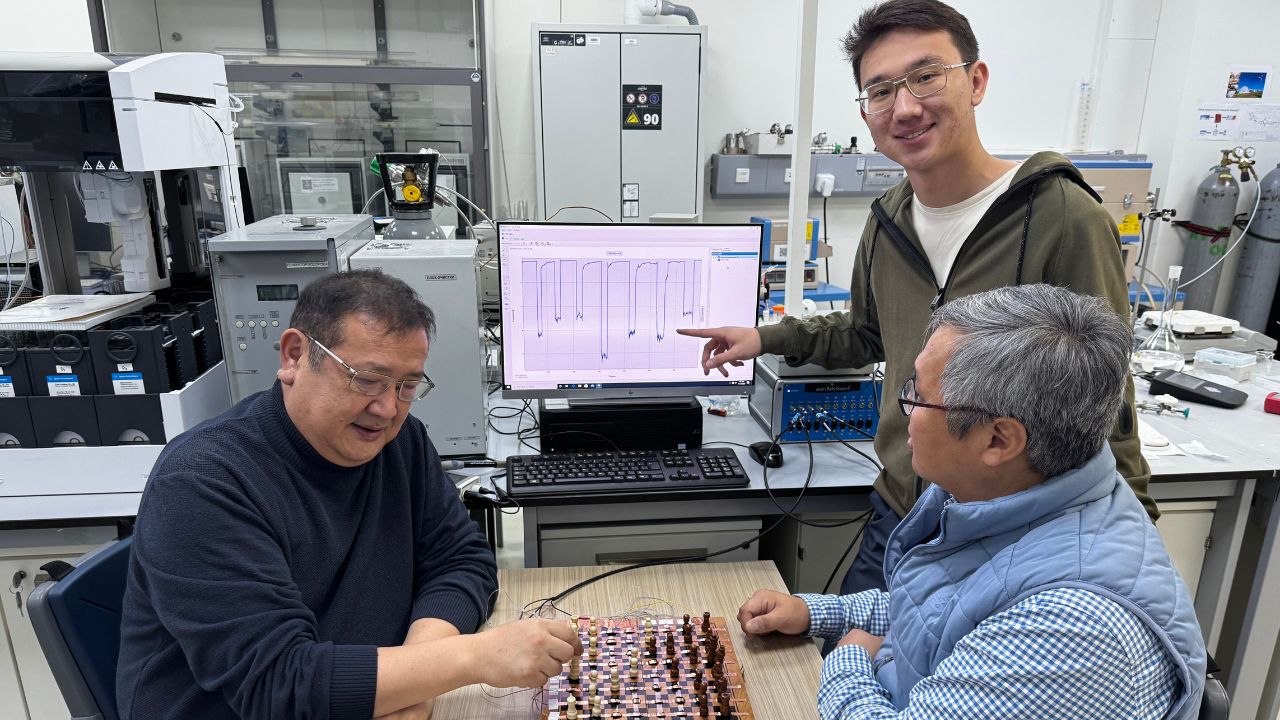
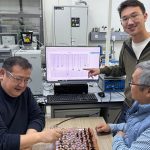
A third-year chemistry major, Sanzhar Abish, has developed an electrically responsive chessboard—an early prototype of touch-sensitive technology—under the joint supervision of Professor Nurxat Nuraje and Assistant Professor Salimgerey Adilov. The device is built using conducting polymer materials engineered by NU’s Conducting Polymer Research Team, marking a promising step toward next-generation tactile sensing systems at Nazarbayev University.
Sanzhar joined the Renewable Energy Laboratory in June 2024, during his second undergraduate year.
“Joining such a dynamic team of experts was a turning point for me. It gave me real hands-on experience in research and helped me discover my true passion for science,” – he shared.
Working alongside researchers in the Conducting Polymer Group, he became fascinated by the electrical behavior of these materials and began exploring their potential for pressure sensors. At the suggestion of Prof. Nuraje, he set out to design a chessboard capable of detecting touch through changes in conductivity. After several iterations, he produced a functional prototype that responds to applied pressure by altering its electrical properties.
“This experience showed me how conducting polymers can be effectively applied in tactile sensing technologies,” Sanzhar said. “Now, together with my professors, we are exploring how this concept could be extended to robotics, such as touch-sensitive systems for robotic applications.”
When a chess piece is placed on the board, its weight applies pressure to the conductive polymer layer. The material compresses, reducing internal voids and increasing the real contact area between the copper tape and the ITO-coated PET sheet. As the contact area grows, more continuous conductive pathways form, lowering the electrical resistance. This behavior follows the piezoresistive principle: pressure decreases resistance, and when the pressure is removed, the material relaxes and the resistance returns to its original state.
The project reflects a broader push within the research group to expand how conducting polymers can be used, from smart sensors to advanced energy materials. Earlier this year, the team announced a template-free method for synthesizing multifunctional 3D polymers, enabling porous composite structures suited for high-performance energy storage, sensing technologies, and flexible electronics. The work was published in Scientific Reports (Nature Portfolio).

The group currently leads several funded research initiatives focused on advancing conducting polymer materials:
- Hydrogen Gas Sensing via Nanostructured Conducting Polymers
Led by Professor Nuraje, this project funded by the Ministry of Higher Education and Science develops highly sensitive hydrogen gas sensors capable of detecting concentrations below 1 ppm—among the most sensitive reported globally. Results have appeared in Adv Compos Hybrid Mater (2023) and Scientific Reports (2024). - Energy Applications of Conducting Polymers
Led by Assistant Professor Adilov, this work explores how dopants and composites improve charge-storage capacity. Their recent publication in RSC Advances (2025) demonstrates enhanced performance of polyaniline-based supercapacitors with commercialization potential for Kazakhstan’s energy sector. - Self-Doped Conducting Polymers for Organic Solar Cells
Led by Dr. Kanzhigitova, recipient of the MEHS Young Researcher Grant, this project focuses on materials that improve efficiency and stability in polymer-based photovoltaics, contributing to more sustainable solar-energy technologies.
“The involvement of undergraduate students is especially important—not only to give them hands-on research experience but also to inspire their creativity in developing next-generation technologies,” said Assistant Professor Adilov.