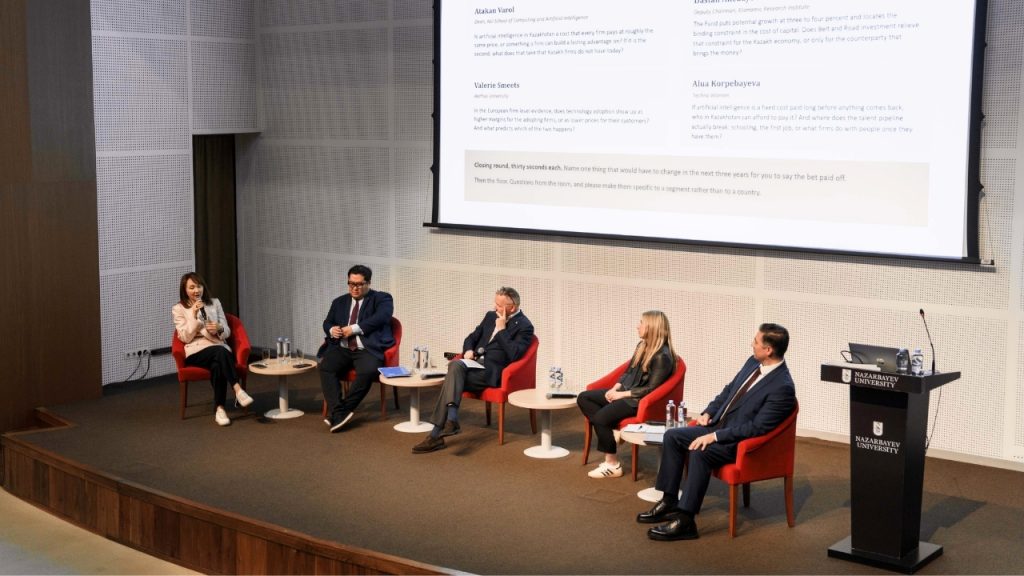
More than 700 participants from around the world, including leading experts in mathematics, gathered at Nazarbayev University for the International Congress on Analysis, Applications and Computation (ISAAC-2025).
On the third day of the Congress, we had the opportunity to speak with Alexei Mailybaev — a specialist in stability theory, bifurcations, and the dynamics of nonlinear systems.
Alexei Mailybaev works at IMPA — the National Institute for Pure and Applied Mathematics in Rio de Janeiro, Brazil, one of the most prestigious mathematical centers in South America. A renowned mathematician of Kazakh origin, Mailybaev was born in Europe and now resides in Brazil. His father is originally from Kokshetau, Kazakhstan.
“My father went to study in Leningrad, where he met my mother — she’s from Vilnius. I was born in Vilnius but grew up in the Moscow region. All of my paternal relatives remained in Kazakhstan,” he shared.
Currently, Mailybaev focuses on applied problems at the intersection of mathematics and theoretical physics. According to him, participating in ISAAC-2025 provides an opportunity to connect with researchers in more “pure” areas of mathematics, exchange ideas, and gain new perspectives on his work.
“I already know many of the participants — we regularly meet at conferences. For instance, Martin Hairer — I gave a lecture on a related topic at their institution in Switzerland last year. I also met colleagues from Siberia, which is a rare opportunity nowadays,” he noted.
We took the opportunity to ask him what areas are currently considered key in mathematics. In response, Mailybaev highlighted the particular importance of artificial intelligence: “As we all see, artificial intelligence is rapidly evolving. It’s an extremely important applied field in which we must continue to advance. Most countries are still far behind the global leaders — such as the United States, China, and the United Kingdom.”
He also shared his thoughts on Kazakhstan’s mathematical school: “From Soviet times, I know that Kazakhstan has always had strong researchers. I’m less familiar with the current scientific landscape since I live far away. But now I see that there are some very serious young scientists here. It’s a pleasure to see both them and the conditions they work in,” he added.
Alexei Mailybaev was also awarded the Satpayev Medal — named after the first president of the National Academy of Sciences under the President of the Republic of Kazakhstan. The medal was presented by the Academy’s Vice President, academician Askar Dzhumadildayev.
“Kazakhstan is a country with a relatively small population, and we deeply value those who have achieved international recognition. Alexei works in Brazil and is an outstanding scientist with a permanent position. We are pleased to welcome him here and want to express our appreciation by awarding him this medal,” said Dzhumadildayev.
On the first day of the Congress, Alexei Mailybaev delivered a plenary lecture titled “Spontaneous Stochasticity.”