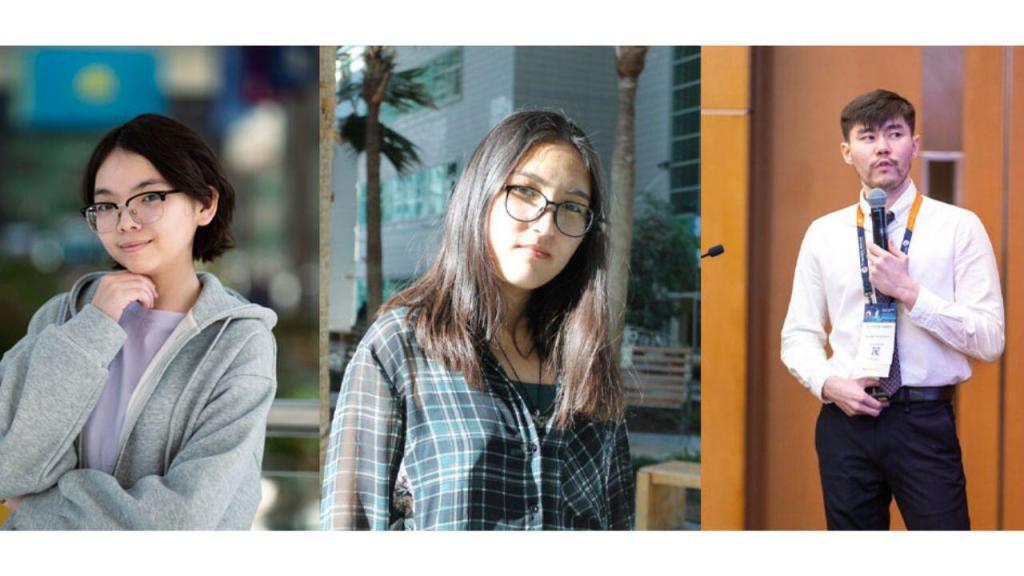
The article was published by weproject.media.
Ayana Batyrbaeva, 19 years old, from Astana, student
About Me
I am a second-year student at NU majoring in Mathematics. My interest in science emerged in childhood, thanks to my parents. They nurtured my passion to learn new things through books, encyclopedias, and documentary programs. They always emphasized the importance of education and supported any initiatives, whether it was a school science project or an Olympiad.
Science is an immortal melody that constantly changes its mood, tempo, and rhythm. Once you hear and understand it, you will want to move to its beat.
Scientific Activity
In 2021, when I enrolled in the Foundation program, classes were held online. So, I joined a research group in Taraz. Our main goal was to identify acute problems in Kazakhstan’s water sector, the reasons for their emergence, and possible solutions. There were six of us in the group, including myself. In 2022, two of our scientific articles were published in Scopus Elsevier in the field of geology and technical sciences. Scopus Elsevier is one of the most authoritative international databases of scientific literature.
Currently, I am a member of the green energy and environmental research group led by Professor Woojin Lee at NU. We are studying the amount of microplastics and nanoplastics in drinking water and their impact on the human body.
I collect water samples and analyze them under a light microscope to understand the color, size, shape, and possible quantity of microplastics. I also conduct analysis using Raman spectroscopy, which helps determine the structure of particles and understand whether they are microplastics or not.
Science at NU
Developing students’ scientific potential is one of the key tasks of NU. Most of our professors, besides teaching, are actively involved in their scientific research. Students can join them as research assistants. This is a popular practice. Usually, from the second or third year onwards, students can work as research assistants on a paid basis.
The university actively promotes scientific activities, allowing students to learn about job vacancies and various opportunities. Financial and technical components are important in scientific activities, as quality equipment is necessary for conducting experiments and obtaining accurate results. In this regard, I can say that the university possesses essential reagents, laboratories, and equipment for our research group.
There is also an opportunity to join academic student clubs at the university, which conduct their own research, participate in prestigious international competitions, and win prizes.
Prospects for Young Scientists
The scientific community in our country is gradually growing. There are increasing opportunities for young scientists: research funds that help to improve qualifications and gain experience abroad, grants for master’s and doctoral programs, and paid internships.
I hope that the scientific sector will continue to develop, and that we, the younger generation, will increasingly find ourselves in this field.
Plans
After graduating from university, I plan to apply for a master’s degree. Currently, I continue to combine studies with research on micro and nanoplastics in water. I will share the results of my research, publish articles with my colleagues and professors, and participate in scientific conferences, seminars, and symposiums.
Jamila Kulchukova, 24 years old, from Astana, student, research assistant
About Me
I am a first-year master’s program student in the field of physics at NU.
I have always wanted to be a scientist. In my childhood, I loved watching documentaries on National Geographic and Discovery channels, and I immersed myself in encyclopedias. So, when I enrolled in the Foundation program at NU in 2017, I already had a goal – to join a research group. At that time, I did not know exactly what I wanted to do. I was interested in everything: geography, medicine, astronomy, and programming.
For a long time, I considered becoming a meteorologist and studying climate. But since the university doesn’t offer such a specialty, I chose physics – it’s a fundamental science.
Scientific Activity
I am involved in singular optics and topological photonics: researching phase singularities in the optical field, analyzing topological reactions associated with them, and studying the influence of symmetry in the system.
The main subject of my work is vortex rings. They are like smoke rings, but instead of smoke it’s light. My work is theoretical. I do not work with equipment; instead, I conduct experiments on a computer: creating simulations, generating animations, drawing graphs, and analyzing them.
I started seriously working on the project during my senior year. Before that, I delved into the topic: read articles, took several mathematics courses, consulted with my supervisor, and prepared for writing my bachelor’s thesis.
I have been working on my project for almost two years. Even in graduate school, I chose to stay at NU, partially to continue my work.
In February, my first article was published in a Q1 journal, where I am the first author. This is a significant achievement for me. Recently, I won the Optica Women Scholars 2024 grant from the Optica Foundation. It is awarded annually to 20 women worldwide who are engaged in research in the field of optics and photonics. Thanks to the grant, I will be able to cover expenses for visits to foreign laboratories and conferences, where I have been invited to speak.
Science at NU
NU offers many opportunities. It is easy to talk to professors, ask them to become your research supervisor, which they often mention during student meetings. Fairs and exhibitions is where professors invite students to join their research groups.
Every October, the university hosts NU Research Days, where you can learn more about projects and research groups.
Computer laboratories are always available. You can find the program you need there, and if it is not available, it will be installed for you.
NU provides a good foundation for starting a scientific career.
Prospects for Young Scientists
The scientific community in Kazakhstan is still developing. We do not yet have the same authority as Western scientists. But we are moving towards it.
It is always pleasant to hear about a Kazakhstani scientist making a discovery, publishing in a good journal, winning an award, or grant at the international level. Because it is something new for us. It is great that this is happening more and more often.
Young scientists have good prospects, but there is a big problem – funding. This can be talked about endlessly, and I hope that in the future, we will not have to worry about the availability of funds.
Plans
After completing my master’s degree, I will pursue a PhD. I have a couple of good research groups in mind that I can join.
Now, I am focused on building a strong portfolio. I am working on my next article, which I plan to complete by the end of the year.
Thanks to the grant I won, I will have a busy summer: I have planned two conferences and an internship in European laboratories. I also plan to start my third article if the results during the internships allow it. By the end of the year, I will begin working on my master’s thesis and concentrate on successfully obtaining my degree.
I want to become a professor. It is my childhood dream.
Galymzhan Serikov, 24 years old, from Astana, Assistant Professor in Scientific Research
About Me
I am a scientist. My work is related to natural resources, mainly oil, and environmentally friendly methods of extraction.
Everyone knows that our country is rich in oil. But few know how it is extracted. Many imagine oil as a black viscous substance. In reality, depending on quality and composition, it can be green, yellow, and even white. And oil is not simply stored in the depths of the earth but in the pores of rocks.
There are many interesting aspects to oil extraction. That is why I study environmentally friendly methods and techniques.
Scientific Activity
Four years ago, I began actively pursuing science. During this time, my colleagues and I have written 12 scientific papers, four of which have been published in reputable journals listed in Q1. This category includes the most prestigious publications with the highest citation rates.
My first project was related to the Karagandy coal basin and involved the utilization of carbon dioxide. In Karagandy they mine the coal, but they can also extract methane. This is a natural and explosive gas. Extracting it after pumping out methane would be safer. And carbon dioxide can be injected into the resulting fractures. I used various software for virtual modeling of this process to explore possible development scenarios.
Currently, I am actively working on a polymer flooding project. This is one of the alternative methods of oil extraction. The simplest method is when oil comes to the surface due to high natural pressure underground. Oil can also be extracted by injecting water or gas into wells. We worked on doing this with natural polymers. Polymers are like molecular toy constructors. Like LEGO, they can be connected into long chains to make the material flexible, strong, or viscous, as in our case.
For our research, we found several good alternatives to synthetic polymers. The advantage of natural polymers is that they can decompose without harming the environment.
We presented this project at the Offshore Technology Conference. Scientists from all over the world gather at this venue annually to discuss ideas and discoveries in the field of hydrocarbon extraction. Our project received wide recognition among experts, and particular interest was shown by the British oil and gas company Shell – one of the main players in the industry.
Science at NU
The laboratories at NU have all the necessary conditions and equipment at the level of international centers. This plays a significant role in developing the scientific potential of students.
Professors influenced my development. My academic advisor, Azza Hashim, worked with both theory and practice.
Funding covers necessary materials, such as polymers for experiments. Additional expenses such as software subscriptions, conference participation, and publication fees are also covered.
We can assemble teams and are not limited to scientists only from our university. This is important because several people from different parts of the world may be working on similar ideas simultaneously.
Prospects for Young Scientists
I never thought I would become a scientist. In society, this profession is not associated with high income, authority, or a social package. Therefore, much depends on the enthusiasm of young scientists who are passionate about their projects.
Usually, the career path of a young scientist looks like this: starting as a laboratory assistant or junior researcher during undergraduate studies. Then working together with a professor to learn research methods. With experience, the range of tasks and responsibilities will increase. Further – participation in international conferences, working in teams with other scientists. This scheme is suitable for those who want to find a starting point for their scientific activities.
Plans
I plan to complete my master’s degree and pursue a Ph.D. I am considering universities in the Middle East and a research institute in Australia.