The rapid development of commercial and scientific space programs requires next-generation radiation-resistant optoelectronics and photovoltaics. Organic photodiodes and photovoltaics hold great promise for the fabrication of cost-effective and ultralight optoelectronic and energy-harvesting devices. They are prominent candidates for space applications as the most lightweight among all inorganic and perovskite counterparts.
Prof. Brus’ group conducted a comprehensive quantitative analysis of the photodiode and photovoltaic characteristics of organic non-fullerene devices before and after exposure to proton irradiation. While an expected initial performance reduction happened under the photodiode and photovoltaic operation modes, a hitherto unknown self-healing effect in the organic devices was observed for several days after the extreme proton irradiation. The research team investigated the organic bulk-heterojunction material properties and the multi-mechanisms recombination processes before and after irradiation, as well as during the self-healing phase. This analysis provides a deep understanding of the changes occurring in the device physics and points toward the relevant aspects of the self-healing mechanism related to the dynamics of proton-induced traps in the bulk of the organic active layer.
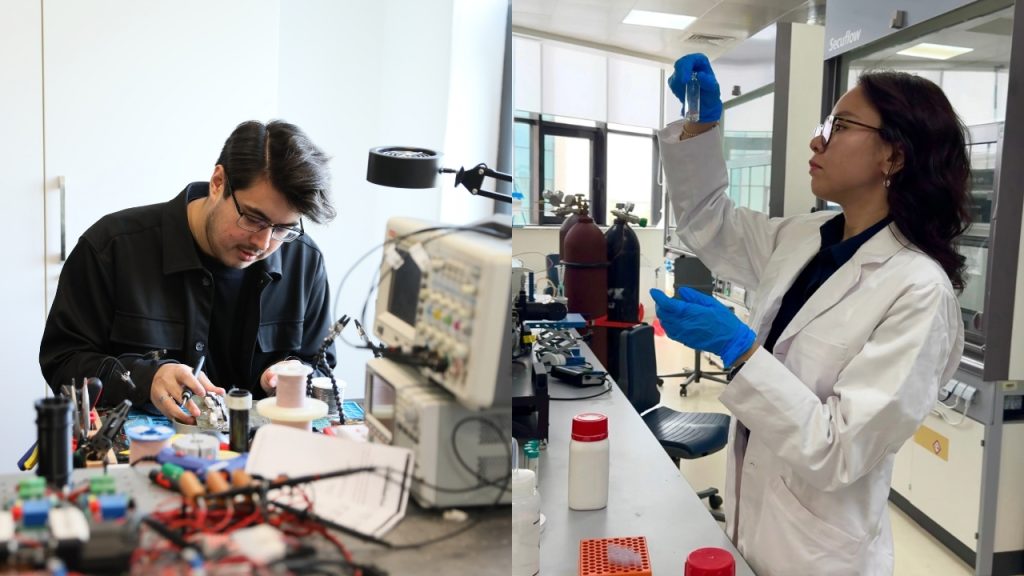
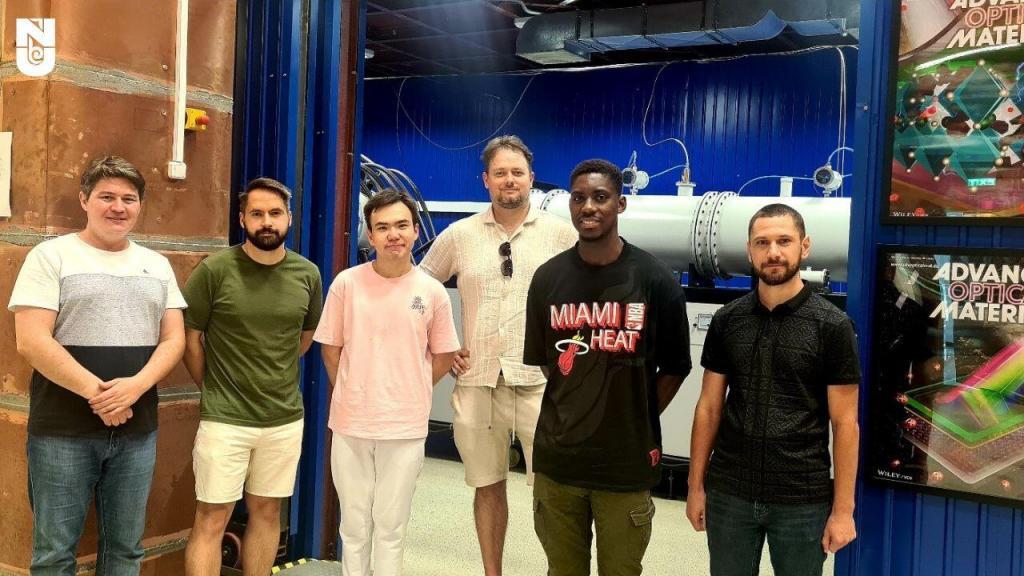
All experimental results of material processing, device fabrication, proton irradiation, and materials/device characterization were carried out at NU by postdocs Dr. Hryhorii Parkhomenko, Dr. Andrii Mostovyi, Dr. Mykhalo Solovan, and Ph.D. student Gulnur Akhtanova in close and fruitful collaboration with Dr. Marat Kaikanov, who is developing an on-campus INURA proton accelerator.
This contribution will be interesting to a broad range of material scientists, device physicists, and engineers, as the synergy of record lightweight features and first discovered self-healing of proton-induced damage in organic photodiodes and solar cells highlights their great potential for applications in rapidly emerging space technology.
The findings are summarized in a paper recently accepted for publication in Advanced Energy Materials, one of the highest-profile journals in the world.