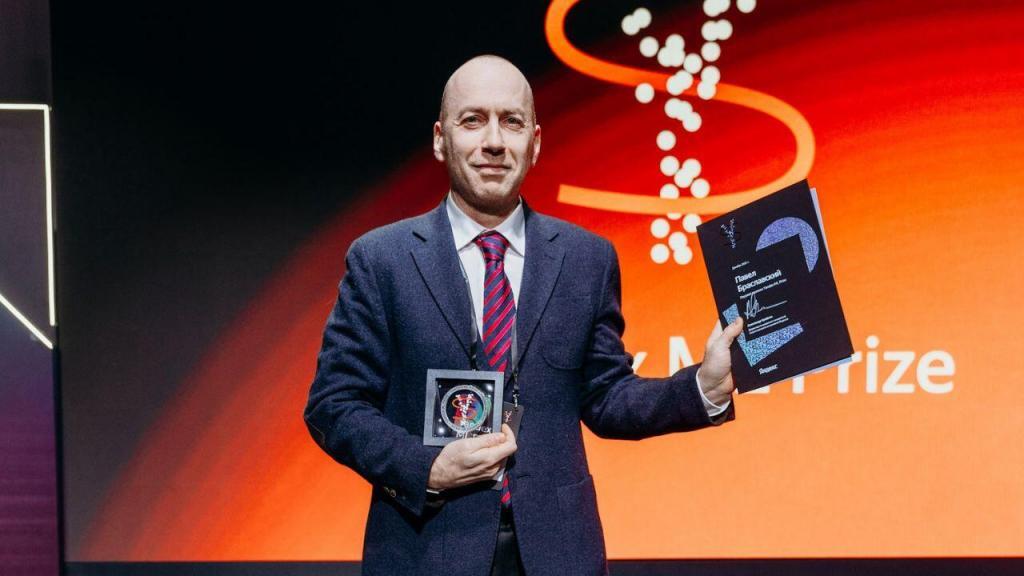
Researchers from 11 countries working in speech recognition and synthesis, computer vision, information retrieval, natural language processing and generative models could be nominated for the prize in six categories.
Pavel Braslavskii’s award-winning work addresses many problems, from computational humour to question answering and transfers learning between domains and languages. For example, his latest work, accepted for the top-level conference Empirical Methods in Natural Language Processing (EMNLP), investigates the robustness and transferability of humour recognition models. Such models classify a short text as either funny or unfunny. With the development of conversational artificial intelligence, the problem is particularly relevant: machines need to respond appropriately to human jokes. In this paper, the authors show that models trained on existing datasets often overfit and perform poorly on data that differs from what they “saw” during training. In addition, some models can be easily “fooled” by small changes in the test data (so-called “adversarial attacks”). The problem can be mitigated by training models on more diverse data. At the same time, modern large language models show more stable, though not ideal, humour recognition behaviour.
Pavel Braslavskii joined the Department of Computer Science at NU in August 2023. He is currently working with a team of students to create Kazakh datasets for training and evaluating language models.