
Nazarbayev University Graduate School of Business (NUGSB) has rapidly become a top destination for business education in Central Asia, thanks partly to a long-standing partnership with Duke University’s Fuqua School of Business.
Established to set new standards in higher education and research, NUGSB’s Executive MBA (EMBA) program has positioned itself as a leader in the region.
A Strategic Partnership with Duke
From its inception, NUGSB sought collaboration with globally recognized institutions to develop its curriculum and research capabilities. Since 2009, Duke Fuqua has played a pivotal role in shaping NUGSB’s academic framework, assisting with faculty recruitment, program design, and quality assurance.
“The partnership played a major role in my decision to attend NUGSB,” shares Dana Iskakova, MBA ’22. “I was considering U.S. schools, but discovering the Duke connection convinced me that I could receive a top-tier education while staying close to my family. Looking back, it was one of the best decisions I’ve ever made.”
The Fuqua faculty were instrumental in launching the EMBA program in 2013, initially teaching all courses. Today, the program continues to benefit from Duke’s expertise, with faculty involvement in research collaboration and admissions oversight.
A Leading EMBA Program in Central Asia
Now in its second decade, NUGSB’s Executive MBA program has grown into one of the most competitive in the region. The 2025 cohort includes 38 executives with an average of 15 years of professional experience across key industries such as oil and gas, finance, and hospitality.
“Developing an Executive MBA program is extremely challenging because you need to convince top executives to commit their weekends to studying,” notes Joep Konings, Dean of NUGSB. “Now, 10 years down the road, it’s one of the most successful programs in Central Asia. That Duke experience is a very important leverage.”
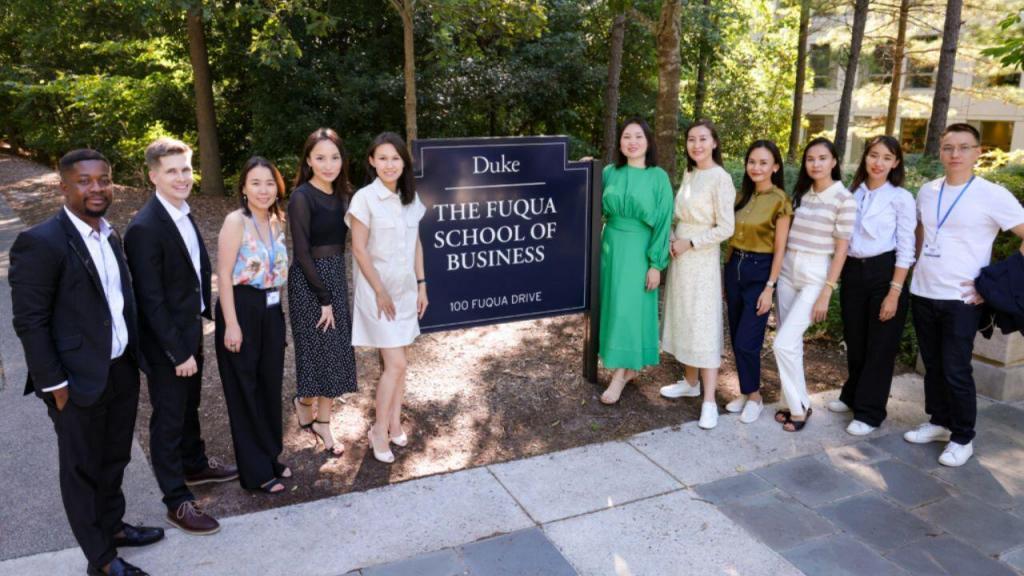
A key feature of the program is a 10-day residency at Duke University, allowing students to take courses on Fuqua’s campus while earning a Duke certificate in global management—a major draw for Kazakhstan’s top business leaders.
.jpg "How Duke Fuqua Helped Build a Leading Business School in Central Asia 1")
A Growing Impact on Kazakhstan’s Business Landscape
NUGSB graduates are making a tangible impact across multiple industries. Around 50% of EMBA graduates transition into entrepreneurship, launching businesses in fields such as renewable energy, healthcare, and technology.
“These are top-tier executives who, after completing the program, often drive major transformations within their companies,” says Dean Konings. One graduate founded a multimillion-dollar solar energy company, while another built a chain of medical centers specializing in traditional Chinese medicine.
Women’s leadership has also been a growing focus, with the full-time MBA class being 60% female and EMBA cohorts ranging from 20-30% women. “The women in this program are among the most ambitious and capable professionals in the region,” Konings adds. “They are going to be the ones redefining leadership in this space.”
The Future of NUGSB & Duke’s Collaboration
NUGSB’s partnership with Duke Fuqua is set to continue through at least 2026, with discussions on expanding collaboration in areas like sustainability and climate change. Given Kazakhstan’s rich energy resources, NUGSB aims to leverage Duke’s expertise to develop climate-conscious business strategies for the region.
Looking ahead, NUGSB is also strengthening its alumni network, drawing inspiration from Duke’s strong global community. Iskakova, who attended a Duke Alumni Reunion, hopes to see the same level of long-term engagement at NUGSB.
“I truly believe NUGSB is shaping Kazakhstan’s current and future business leaders,” she says.
To learn more about how NUGSB and Duke Fuqua are building a world-class business school in Kazakhstan, read the full article on Poets & Quants.